How to Get Brand Deals as a Creator (Without an Agent Taking 20%)
If you make content and you've ever wondered how creators with smaller followings than yours are pulling in $2,000 per Reel, the answer isn't luck. It's usually a system. Brand deals don't fall in your lap because you posted a good video. They show up because you put yourself in front of the right brands, in the right way, with the right pitch.
This is a step-by-step guide to landing your first paid brand partnership and turning it into a repeatable income stream. No fluff, no "build your personal brand for two years first" advice. Just the actual playbook creators use to start getting paid.
And one important thing up front: you do not need a traditional talent agent to get brand deals. Most creators don't have one. Most creators who do have one are giving up 15 to 20 percent of every deal they close. There are better paths now.
What is a brand deal, exactly?
A brand deal is a paid partnership where a company pays you to create content featuring their product or service. That content lives on your channels (Instagram, TikTok, YouTube, your podcast, wherever your audience is) and the brand benefits from your trust with that audience.
Brand deals come in a few flavors:
- Sponsored posts: You create one or more pieces of content featuring the brand. Flat fee, paid up front or on delivery.
- UGC (user generated content): You create content for the brand to use on their own channels. You don't post it on yours. Lower fees but easier to land and faster to produce.
- Affiliate partnerships: You get a commission on every sale your link drives. Low risk for the brand, unlimited upside for you if the product converts.
- Ambassador programs: Longer-term deals, usually 3 to 12 months, where you become an ongoing face of the brand. Often a mix of flat fees, free product, and affiliate.
- Whitelisting and paid amplification: The brand pays to run your content as ads on their accounts. Premium money, often $500 to $5,000 on top of the base deal.
Most creators starting out land sponsored posts and UGC first. Ambassador deals come later, once you've proven you can actually drive results.
How many followers do you need to get brand deals?
Engagement beats follower count. A 2,000-follower creator with active fans is more valuable to the right brand than 50,000 passive followers.
This is the most common question, and the most misleading one. The honest answer: it depends on engagement, niche, and content quality, not raw follower count.
Some real benchmarks from the field:
- Under 2,000 followers: You can absolutely land UGC deals (the brand pays you for content they use, not for your audience). $100 to $500 per video is realistic.
- 2,000 to 15,000 followers: The sweet spot for niche brand deals. Boutique brands love creators in this range because the audience is engaged and the rates are reasonable. $250 to $2,500 per post is normal.
- 15,000 to 100,000: You're in mid-tier territory. Bigger brands take you seriously. $1,000 to $10,000 per integrated post is normal depending on niche.
- 100,000+: You're a known quantity. Rates climb fast, but so do brand expectations around exclusivity, usage rights, and turnaround.
If you have 1,500 highly engaged followers in a tight niche (think pickleball, sourdough, sober curious lifestyle, indoor gardening) you are far more valuable to the right brand than someone with 50,000 generic lifestyle followers. Engagement and fit beat scale every time at the lower end of the market.
Step 1: Get your content pillars locked in
Before you pitch a single brand, you need to know what you're known for. Brands aren't buying "a creator." They're buying access to a specific audience that cares about a specific thing.
Pick 2 to 4 content pillars and stick with them. A pillar is a topic you post about consistently. Examples:
- A skincare creator might run pillars: product reviews, morning routines, ingredient breakdowns, before/after transformations.
- A finance creator: budget breakdowns, side hustle income reports, beginner investing, money mindset.
- A food creator: 15-minute weeknight dinners, pantry staples, cooking technique, restaurant recreations.
If a brand can't tell what your channel is about in five seconds, they will not pitch you. Pillars solve that. They also make it dramatically easier to identify which brands are actually a fit for your audience.
A practical test: write your pillars down. Now look at your last 12 posts. If most of them don't fit cleanly into a pillar, you have a positioning problem to fix before you start pitching.
Step 2: Build a media kit that makes brands say yes
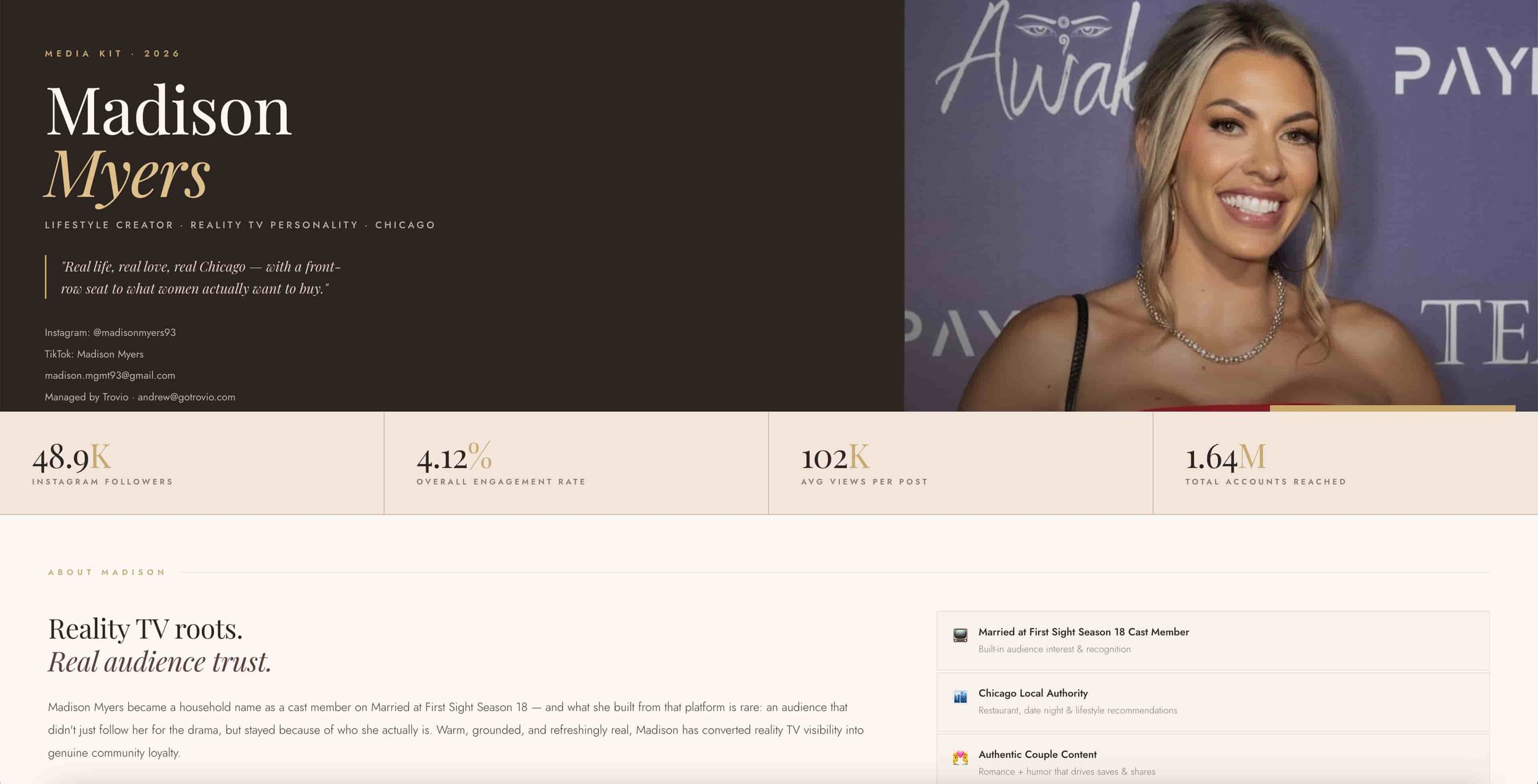
A real Trovio-built creator media kit. The 4.12% engagement rate, audience reach numbers, and clear positioning ("reality TV roots, real audience trust") are the kinds of details brands actually scan for
Your media kit is your sales sheet. It's the first thing a brand will look at when you pitch, and the thing they'll forward internally to get budget approved. A weak media kit kills deals before they start.
A good creator media kit fits on one or two pages and includes:
- Who you are: One sentence on what you make and who it's for.
- Your audience: Demographics (age, gender split, top locations), follower counts across platforms, average reach per post.
- Your performance: Engagement rate, average views, recent content that hit. Brands care about reach far more than vanity follower counts.
- Your content pillars: Show your range with screenshots of your best posts in each pillar.
- Past brand work: Even unpaid collabs count. If you've worked with a brand before, show it.
- Rates or a starting point: You don't have to publish full pricing, but signaling "partnerships start at $X" filters out the brands who want it for free.
- How to reach you: Email, not Instagram DMs. Brands working off a budget approval timeline can't be relying on DMs.
If you've never made one before, the bar is lower than you think. A clean PDF made in Canva or a simple webpage is plenty. What matters is that the data is real and the design isn't an eyesore.
Step 3: Build your target brand list
Most creators try to land brand deals by waiting in the inbox. That's a losing strategy. The creators getting paid are the ones doing outbound.
Build a list of 30 to 50 brands you'd genuinely want to work with. Then filter ruthlessly:
- Audience overlap: Does the brand's customer look like your follower? If you make sober lifestyle content, a wine brand is wrong even if you love wine.
- Brand size: Founder-led DTC brands (especially in beauty, skincare, wellness, food, and lifestyle) are the easiest to land deals with as a smaller creator. They move fast, they have budget, and they value authenticity.
- Existing creator program: Look at the brand's tagged photos. If they're already working with creators in your size range, that's a green light. If they only work with celebrities, you're punching above your weight.
- Right contact: You want the brand partnerships lead, the influencer marketing manager, the social manager, or (for smaller brands) the founder. "info@" emails go nowhere.
Tools like Apollo, Hunter, and LinkedIn Sales Navigator can help you find direct contacts. For smaller DTC brands, the founder's email is often discoverable from podcast appearances or their company about page.
Step 4: Send pitches that actually get replies
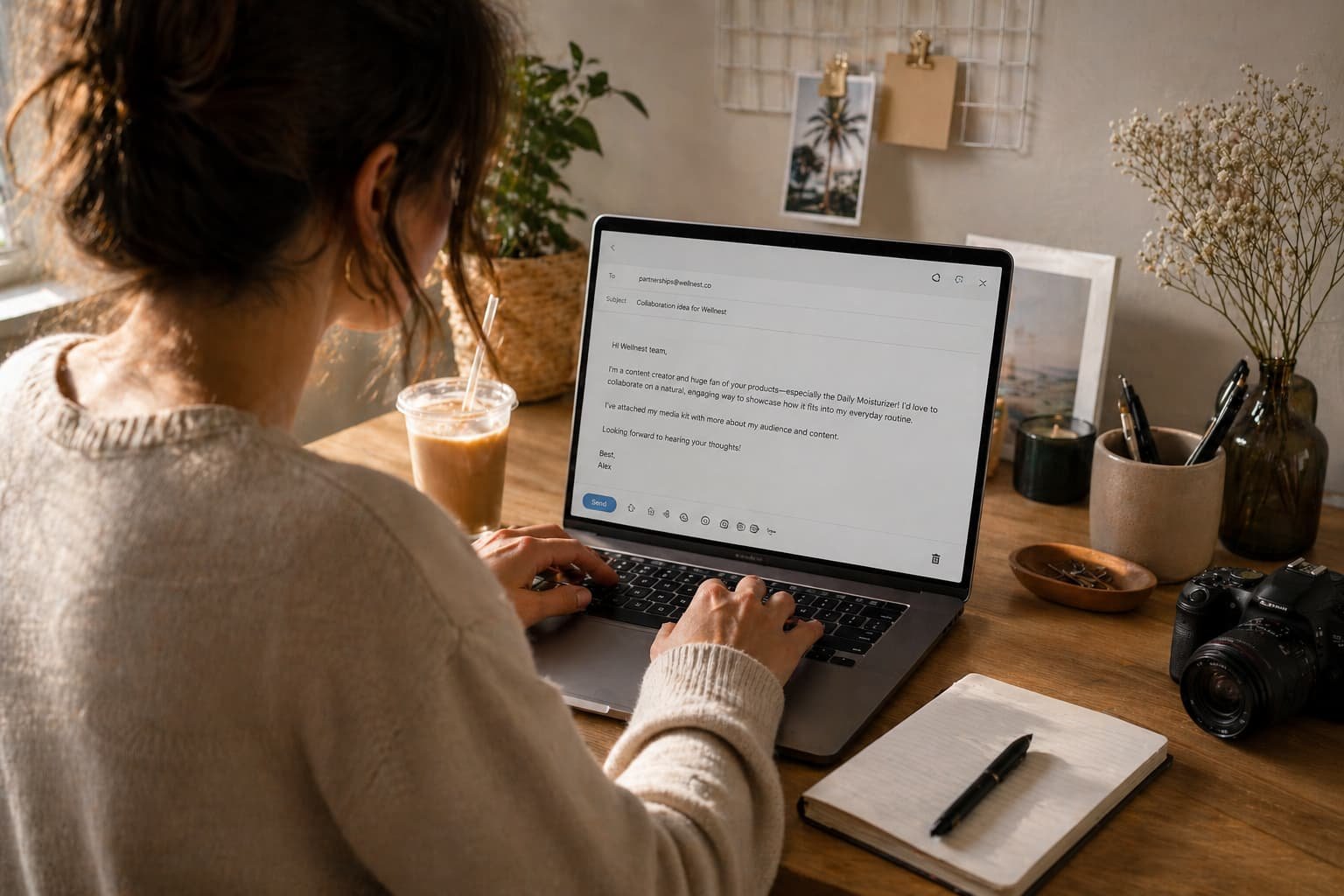
A solid starting point for a brand pitch: a specific subject line, a concrete product mentioned, and a clear ask. The next level up is replacing "I'd love to collaborate" with a specific content idea the brand can picture.
Here's where most creators fall apart. They write generic, three-paragraph self-introductions with their follower counts in the first sentence. Brands delete those without finishing them.
A pitch that converts has five things:
- A specific subject line: "Quick collab idea for [brand]" beats "Partnership inquiry." Reference something real about the brand.
- Proof you've done your homework: Mention a specific product, a recent campaign, a founder interview. Not flattery. Specificity.
- A concrete content idea: Don't ask if they want to work with you. Tell them what you'd make. "I'd love to do a one-take morning routine featuring your serum, focused on the texture moment because that's what your reviews keep mentioning."
- Your audience in one line: Who they are, what they care about, why they're a fit for this brand. Save the full media kit for the attachment.
- A clear ask: "Open to a paid partnership in the $X to $Y range. Available to shoot in the next two weeks." Make it easy to say yes.
Keep the email under 150 words. Attach the media kit. Send it from a real address with your real name. That's it.
Send 10 pitches a week, every week. Most won't reply. Some will say no. Two or three will start a conversation. Conversations turn into deals.
Step 5: Price your work like you mean it
The fastest way to lose a brand's respect is to undersell. Brands assume the price reflects the quality. If you charge $50 for a Reel because you're afraid to ask for more, the brand will treat the work like it's worth $50.
Rough starting points for a single piece of content (Instagram Reel, TikTok, or equivalent), based on follower count:
- Under 5K: $150 to $500
- 5K to 25K: $500 to $2,000
- 25K to 100K: $1,500 to $7,500
- 100K to 500K: $5,000 to $25,000
- 500K+: $20,000 and up
These are starting points, not gospel. A creator with 10K and a 12 percent engagement rate in a niche like dermatology can absolutely charge mid-tier rates. A creator with 100K passive followers in a generic lifestyle niche may charge less.
Layer pricing for things brands often ask for:
- Usage rights (the brand running your content as ads): add 30 to 100 percent on top of base.
- Exclusivity (you can't post for competitors for X days): add 20 to 50 percent.
- Whitelisting (running ads through your handle): premium add-on, usually $500 to $5,000.
- Rush turnaround: add 25 to 50 percent.
Always send a written agreement before you create. A simple statement of work email covering deliverables, deadline, payment terms, and usage rights protects both sides.
Do you need a talent agent or manager?

ost agencies won't sign creators under 100K followers. Which means the creators who could most use the help are the ones traditional agents refuse to take on.
The traditional creator-economy answer used to be: yes, eventually. An agent finds you deals, negotiates contracts, and chases payment in exchange for 15 to 20 percent of everything you earn from brand work.
That math used to make sense when finding deals required a Rolodex of brand contacts. It makes a lot less sense now.
Here's what an agent actually does:
- Sources brands that fit your audience
- Negotiates rates and contract terms
- Manages timelines and deliverables
- Chases payments and handles paperwork
All of that work is increasingly being automated. Software can match you to brands based on your audience and content. AI can draft your pitch, your rate sheet, your media kit, and your contract terms. Templates handle the paperwork. Tools track payment and timelines.
The catch with traditional agents: most won't sign you unless you're already at 100K plus. So small and mid-tier creators (the people who could most use the help) are the exact people most agencies refuse to take on.
That's the gap Trovio fills. Trovio is a digital talent agent built for creators of every size, from 500 followers to 500,000. It does the brand matching, the pitch drafting, the rate guidance, the media kit creation, and the deal management. The difference: Trovio doesn't take a percentage of your brand deals. You keep 100 percent of what you earn from partnerships. The brands pay Trovio. You don't.
Common mistakes that kill creator brand deals
**Pitching too many brands at once with the same email.**Brands can spot a copy-paste pitch in three seconds. Personalize every send.
**Leading with your follower count.**Brands care about whether your audience converts. Show engagement and fit before you show numbers.
**Saying yes to free product as payment.**Free product is fine for tiny creators just starting out, but it's not a long-term strategy. Once you're past your first three or four brand collabs, your time and content have a real cash value. Charge for it.
**No contract.**Always have something in writing. A scope email is enough at first, but never start production on a handshake from a stranger.
**Missing your deliverable deadline.**The single fastest way to never work with a brand again. Treat brand deadlines like client work, because they are.
**Not following up.**Most deals close on the third or fourth touch. A polite follow-up at day 7 and another at day 14 will land you more work than any single perfect pitch.
How long does it take to land your first brand deal?
If you're starting from a clean slate (decent content, clear pillars, a basic media kit, and you're willing to send 10 pitches a week), most creators land their first paid deal in 4 to 8 weeks. Some land one in week one. Some take three months. The variable is almost always pitch volume.
Once you've closed your first deal, the second is significantly easier. You have a case study. You have proof of execution. You have a number to anchor pricing. The flywheel starts turning.
Your next step
If you remember nothing else from this post, remember this: brand deals are not a follower-count problem. They're a system problem. Creators who treat outreach, pricing, and deal management like a job get paid. Creators who wait to be discovered don't.
If you want to skip the manual work (the hours of researching brands, drafting pitches, building media kits, and negotiating rates) Trovio is built for exactly that. It's a digital talent agent that does the work an agency does, except it works for creators of every size and never takes a cut of your brand earnings.
Start at gotrovio.com.