How Much Should You Charge for a Brand Deal? A Real Pricing Guide for Creators
If you've ever stared at a brand's "what's your rate?" email and frozen, you're not alone. This is the single most uncomfortable moment in the creator economy, and almost nobody talks about it honestly. Most pricing advice online is either written by agencies who are incentivized to push your rates as high as possible (so their cut gets bigger), or by random calculators that spit out a number without understanding what you actually do.
I started Trovio because I watched too many creators leave money on the table. Not because they were bad at what they do, but because nobody ever taught them how this stuff actually works. So here is the most honest, practical guide I can write on creator pricing. No agency-speak, no inflated promises, no formulas that pretend to be physics when they're really just guesses.
Let's get into it.
The honest truth about creator pricing
Here is the thing nobody wants to say out loud: there is no universal formula. Brand deal pricing is closer to freelance consulting than it is to retail. Two creators with identical follower counts can charge wildly different rates based on engagement, niche, audience trust, content quality, and how much effort the deliverable takes. That is not a bug. That is the actual market.
What this means for you: stop looking for the "right" number and start looking for your number. Your number is the price at which you'd feel good doing the work, the brand still wins, and you're not undercutting future-you.
Most creators undercharge. A few overcharge and then wonder why brands ghost them. The goal is to land somewhere in the middle, with the confidence to defend your rate when a brand pushes back.
The baseline math (and why it's only a starting point)
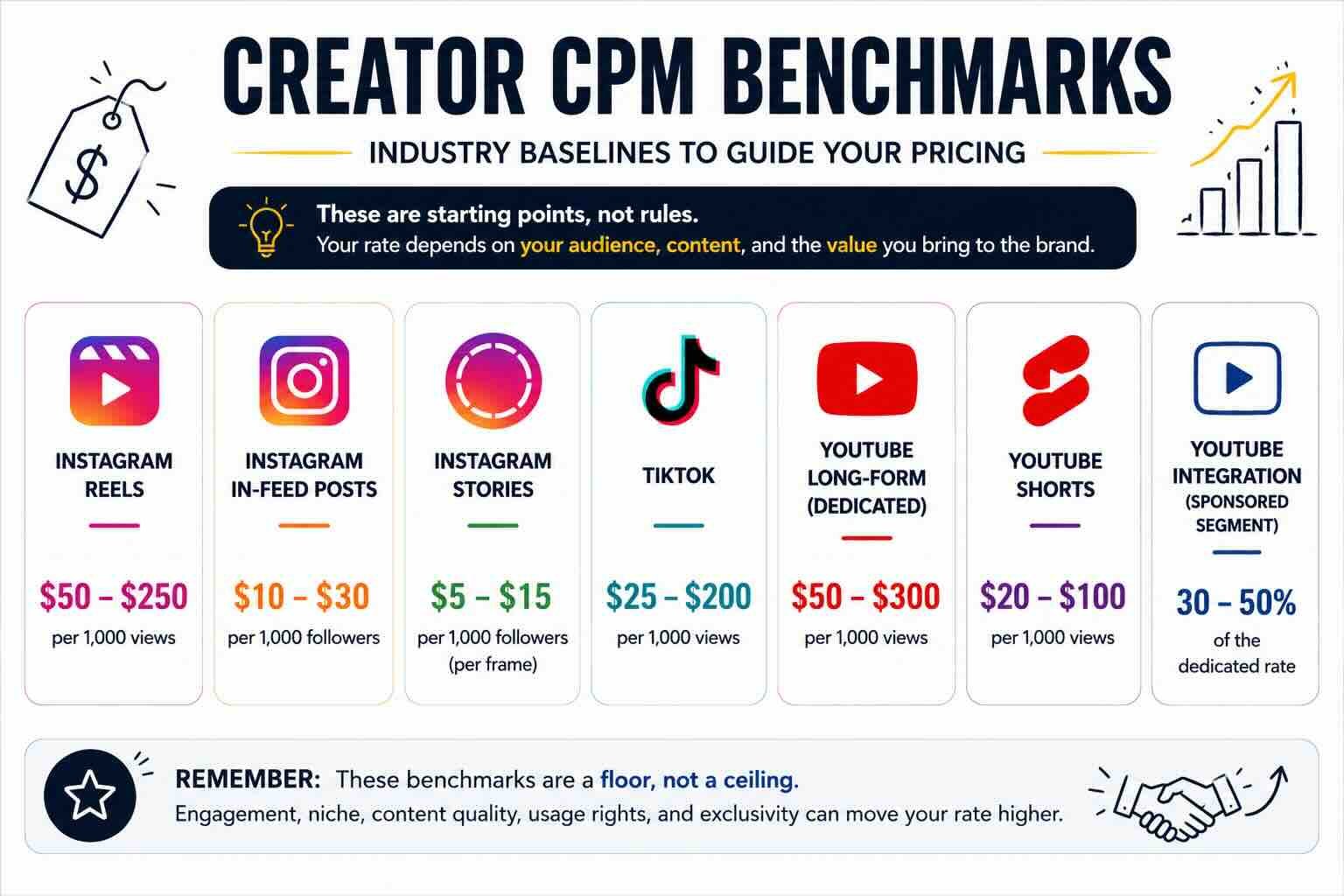
The most common rule of thumb you'll see is the "CPM" model, where CPM stands for cost per thousand impressions or views. The very rough industry baseline looks something like this:
- Instagram Reels: $50 to $250 per 1,000 views
- Instagram in-feed posts: $10 to $30 per 1,000 followers
- Instagram Stories: $5 to $15 per 1,000 followers (per frame)
- TikTok: $25 to $200 per 1,000 views
- YouTube long-form (dedicated): $50 to $300 per 1,000 views
- YouTube Shorts: $20 to $100 per 1,000 views
- YouTube integration (sponsored segment inside a regular video): 30 to 50% of the dedicated rate
I want to be honest about these numbers. They are starting points, not gospel. I have seen 10K-follower creators with niche audiences charge above this range and get it. I have seen 500K-follower creators stuck below it because their engagement is soft. The math gives you a floor, not a ceiling.
Here's a simple example. Say you average 80,000 views per Reel. At $75 per 1,000 views (a reasonable mid-range CPM for an established creator), your baseline rate for one Reel is roughly $6,000. That is the conversation starter, not the deal.
The five things that actually move your rate
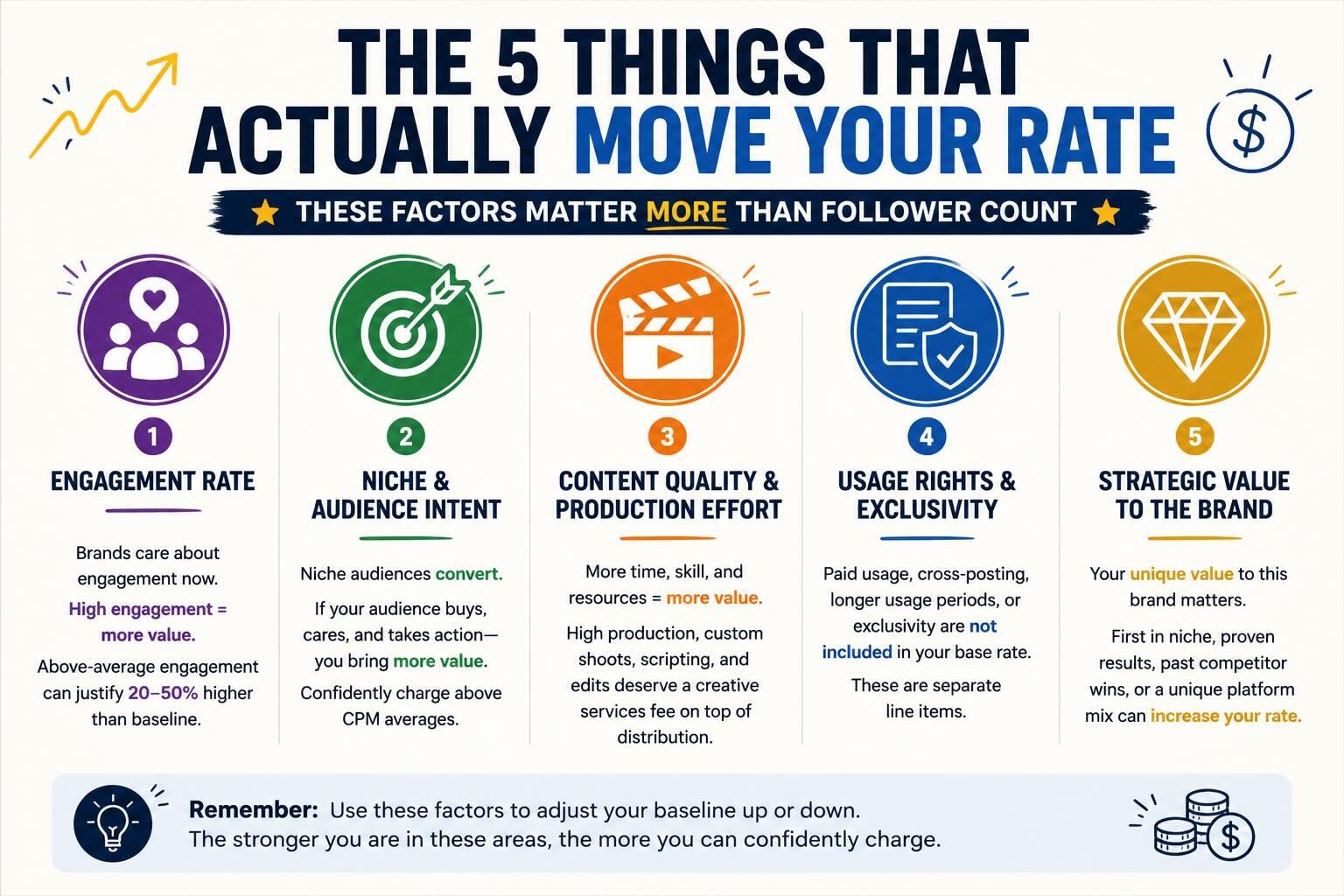
Once you have your baseline, here is what moves the number up or down. I'd argue most of these matter more than your follower count.
1. Engagement rate
This is the one brands actually care about now. A 50K creator with a 6% engagement rate is more valuable than a 500K creator with a 0.5% engagement rate, and brands have figured this out. A healthy engagement rate on Instagram is generally 2 to 4% for creators in the 50K to 500K range. On TikTok, anything above 5% on a sponsored post is strong. If your engagement is above average, you can defend a rate that's 20 to 50% higher than the baseline.
2. Niche and audience intent
A skincare creator with 30K followers who actually buy skincare is worth more to a beauty brand than a general lifestyle creator with 200K who occasionally posts about everything. Niche audiences convert. Brands pay for conversion, even when they say they're paying for "awareness." If you're deeply niched (running, parenting, finance, gardening, queer fashion, BBQ, whatever), you can confidently charge above CPM averages. Generalist creators have to lean harder on volume.
3. Content quality and production effort
A talking-head reaction Reel and a fully scripted, shot, and edited 60-second cinematic ad are not the same product. If a brand wants polished production, custom shooting, multiple revisions, or a specific narrative arc, that is a creative services fee on top of your distribution fee. Think of yourself as a one-person production studio when the deliverable demands it. Don't charge the same for both.
4. Usage rights and exclusivity
This is where most creators leave the most money on the table. If a brand wants to:
- Reuse your content in their own paid ads (paid usage rights)
- Cross-post your content to their own channels (organic usage rights)
- Keep your content live for more than the standard 12 months
- Lock you out of working with competing brands for a period of time (exclusivity)
...each of those is a separate line item. Usage rights are often 25 to 50% of your base rate per 90 days. Exclusivity windows of 30, 60, or 90 days can easily double your base rate. If a brand asks for "perpetual rights" or "all usage," that's another conversation entirely.
A lot of brands will quietly ask for these things in the contract and hope you don't notice. Notice.
5. Strategic value to the brand
This one's softer but real. If you're the first creator in a niche, if you have a unique platform mix, if you have a reputation for moving product, if you've worked with their direct competitor and converted, your value to that specific brand is higher than average. Don't be afraid to factor that in.
A simple framework you can use today
Here's how I'd actually price a deal if I were doing this myself.
Step 1: Set your base rate per deliverable. Use the CPM math above as your starting point. Round to a clean number that feels good in your mouth. If you can't say it confidently on a Zoom call, lower it slightly until you can. Confidence is part of pricing.
Step 2: Add modifiers. Walk through the five factors above. Are you above-average on engagement? Add 20%. Niche audience that converts for this brand? Add another 15%. Heavy production? Add a flat creative fee. Each modifier is a real lever.
Step 3: Add usage rights and exclusivity as separate line items. Never bundle these into your base rate quietly. List them out. This protects you and also signals to the brand that you know what you're doing.
Step 4: Build in revisions. Two rounds of revisions included. Anything beyond that is $X per round. Trust me on this one. The brands who push for unlimited revisions are the same brands who will eat your entire weekend.
Step 5: Have a walk-away number in your head. Before any negotiation, know the number below which you'd rather not do the deal. This is the single most important pricing skill, and it has nothing to do with math. It's about respecting your own time.
Common pricing scenarios (real numbers)
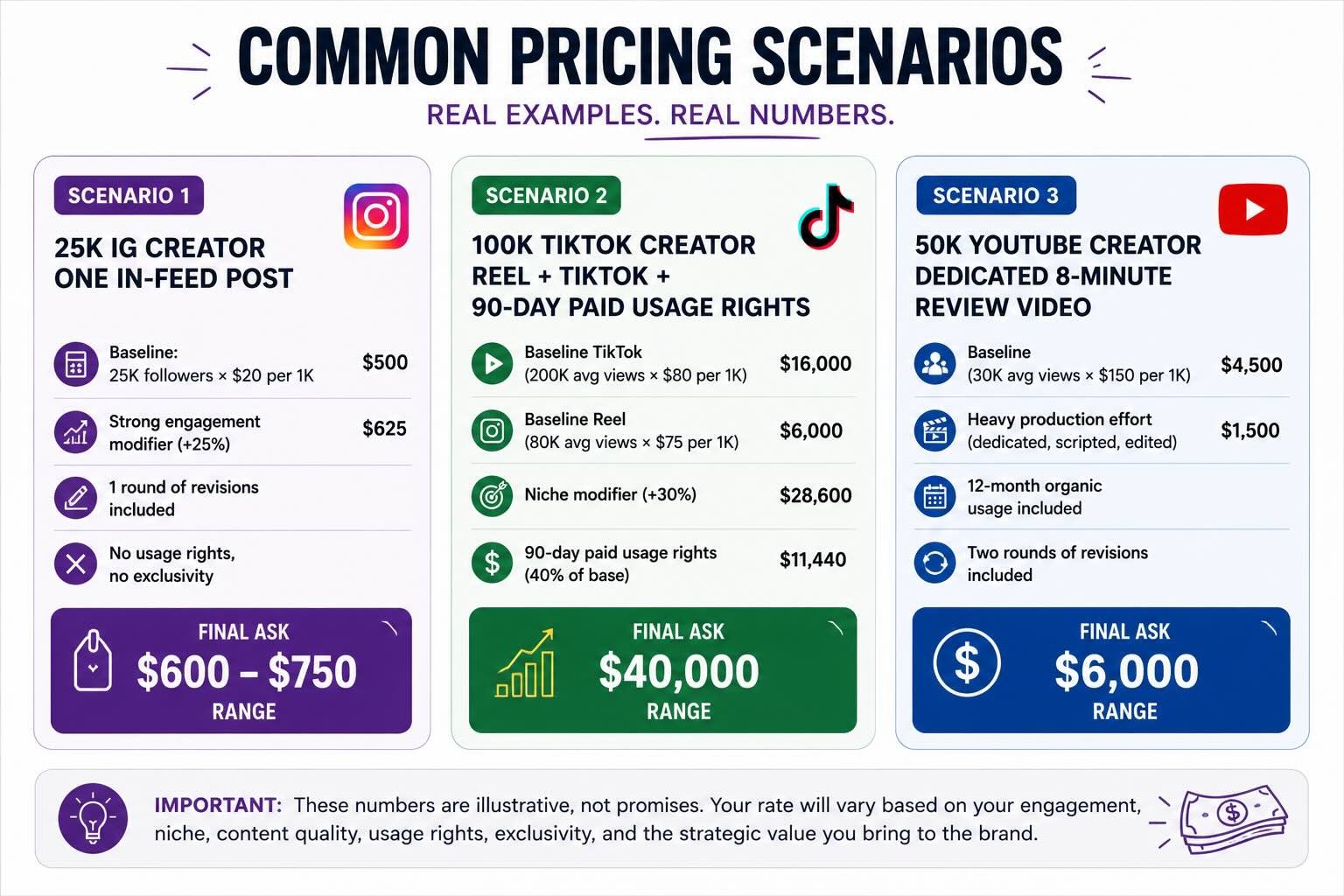
I'll walk through a few rough examples to make this concrete. These numbers are illustrative, not promises. Your situation will vary.
Scenario 1: A 25K Instagram lifestyle creator, one in-feed post.
- Baseline: 25K followers × $20 per 1K = $500
- Strong engagement modifier (+25%): $625
- One round of revisions included
- No usage rights, no exclusivity
- Final ask: $600 to $750 range
Scenario 2: A 100K TikTok creator in the finance niche, one Reel + one TikTok + 90-day paid usage rights.
- Baseline TikTok at $80 per 1K views, averaging 200K views per video: $16,000
- Baseline Reel (same creator on Instagram, 80K avg views): $6,000
- Niche modifier (+30%): $28,600 combined
- 90-day paid usage rights (40% of base): adds $11,440
- Final ask: $40,000 range
Scenario 3: A 50K YouTube creator, dedicated 8-minute review video.
- Baseline: 50K subs, averaging 30K views per video, at $150 per 1K = $4,500
- Heavy production effort (dedicated, scripted, edited): add $1,500 creative fee
- 12-month organic usage included
- Two rounds of revisions
- Final ask: $6,000 range
These numbers will feel high if you've been undercharging, and low if you've been over-quoting. That tells you something either way.
What about smaller creators?
If you have under 10,000 followers, the standard CPM math starts to break down. You're either in product-gifting territory (the brand sends you free stuff in exchange for content) or in the small-deal range, usually $50 to $500 depending on niche, engagement, and platform.
My honest advice for creators in this range: don't work for free unless the brand is genuinely a dream fit and the content will benefit your own portfolio. "Exposure" is not payment. Even a $100 cash deal is a better data point than a $0 gifted deal because it sets a floor for the next conversation.
Also, this is where the agency model actively works against you. Traditional talent agencies won't touch creators under 100K followers, and even when they do, the 15 to 20% cut on a small deal can be the difference between making it worth your time and not. That's a big part of why we built Trovio. Creators of every size deserve real representation, not just the top 1%.
How to actually quote a rate (without panicking)
The mechanics of saying the number out loud matter almost as much as the number itself. A few real tips:
Send rates in writing, not on a call. When a brand asks for your rate on a call, say something like "Let me put together a proper proposal for you and send it over today." This buys you time and signals professionalism.
Quote a range, then anchor high. If your real ask is $5,000, lead with "My rates for this kind of deliverable are typically in the $5,000 to $7,500 range depending on usage and exclusivity." This gives you negotiation room without sounding like you're making it up.
Itemize the deliverables. Don't say "$5,000 for the campaign." Say "$3,500 for the Reel, $1,000 for the 3 Stories, $500 for the carousel." Itemization protects you when scope creeps and makes the brand take the price seriously.
Always send a media kit alongside the quote. Your rate makes more sense in context. If a brand can see your audience demographics, engagement rates, past partnerships, and best-performing content, they're more likely to accept the number without a fight.
Don't apologize for your rate. If the brand says it's too high, the answer is "I understand, here's what I could do at a lower price point" (and then take something out, like usage rights or a deliverable). The answer is never "ok how about half."
When to walk away
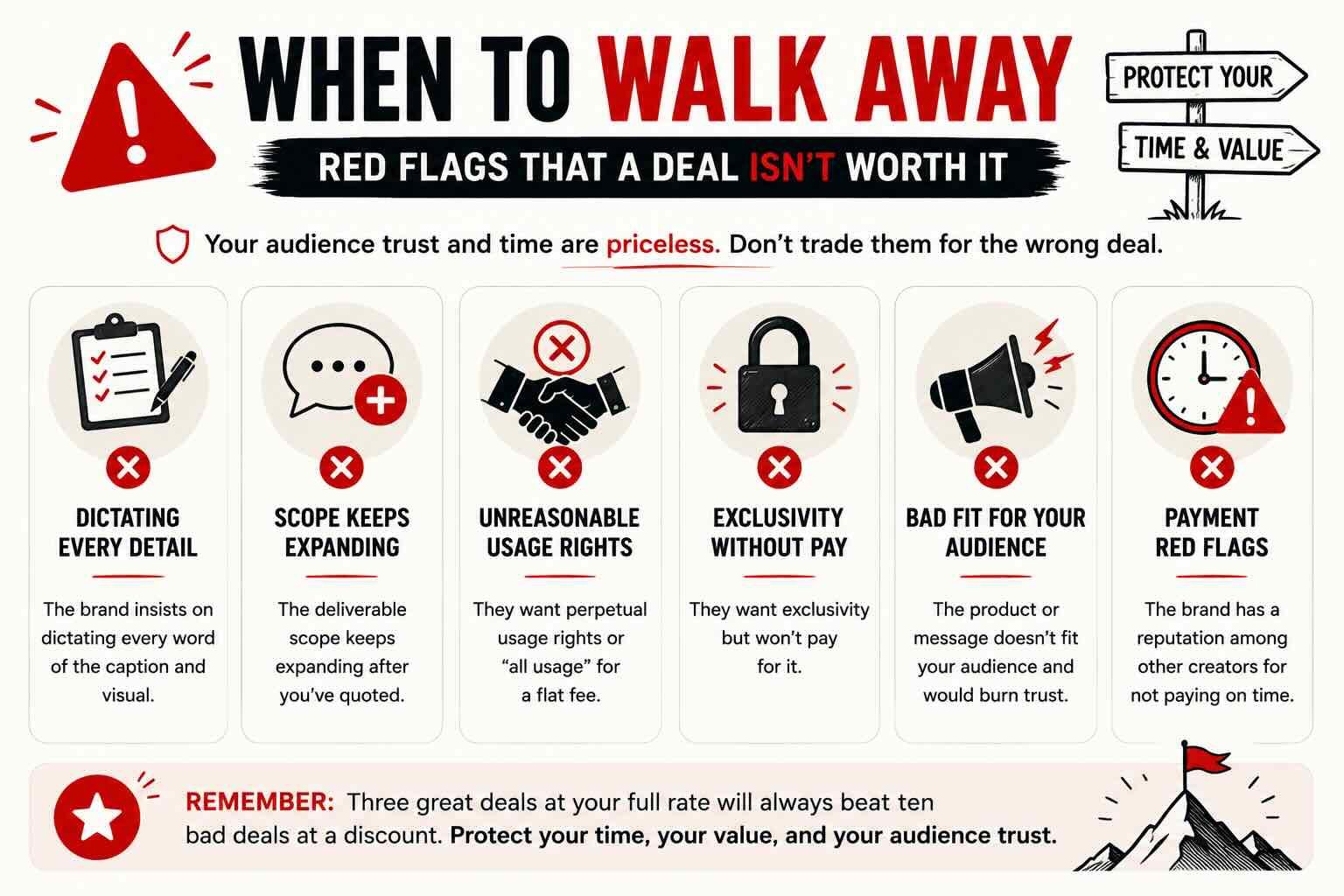
Some deals are not worth doing. Signs a deal isn't worth it:
- The brand insists on dictating every word of the caption and visual
- The deliverable scope keeps expanding after you've quoted
- They want perpetual usage rights for a flat fee
- They want exclusivity but won't pay for it
- The product or message doesn't fit your audience and would burn trust
- The brand has a reputation among other creators for not paying on time
It is genuinely better to do three good deals at your full rate than ten bad deals at a discount. Bad deals don't just cost money. They cost the audience trust you've spent years building. Protect that.
What I'd tell you if we were on a call
If you and I were talking on a call about your first or fiftieth brand deal, here's what I'd actually say: pricing is a skill you build over time. The first few deals will feel weird, you'll quote too low and you'll quote too high, and that's fine. Track what you quoted, track what the brand accepted, and track what the deliverable was. After ten deals, you'll have your own dataset, and you'll know.
The other thing I'd say is that the percentage cut model that agencies use is the single biggest wedge against creator earnings in this industry. A 20% cut on a $40,000 deal is $8,000 that walks out of your pocket. Forever. Across a year of brand work, that adds up to a number that will make you a little angry.
That's the reason Trovio doesn't take a percentage of your brand deals. You keep 100% of what brands pay you. We get paid by the brands directly, on the SaaS side, because we think the agent fee model is a tax on creator income that nobody actually justified in the first place.
If you want a digital agent that handles brand matching, pitch writing, and deal flow without taking a cut of your earnings, that's what we're building at Trovio. Creators of every size, from the first 1,000 followers to the first million, deserve access to the same tools the top 1% have had for years.
But even if Trovio isn't right for you, the goal of this post is bigger than that. Charge what your work is worth. Itemize your deliverables. Protect your usage rights. Walk away from deals that don't respect your time. And every once in a while, when the rate feels scary to ask for, ask for it anyway.
You'll be glad you did.
Andrew Lukas is the CEO and co-founder of Trovio, the digital agent for creators of every size. You can learn more at*gotrovio.com.*