What Is a UGC Creator? Everything You Need to Know in 2026
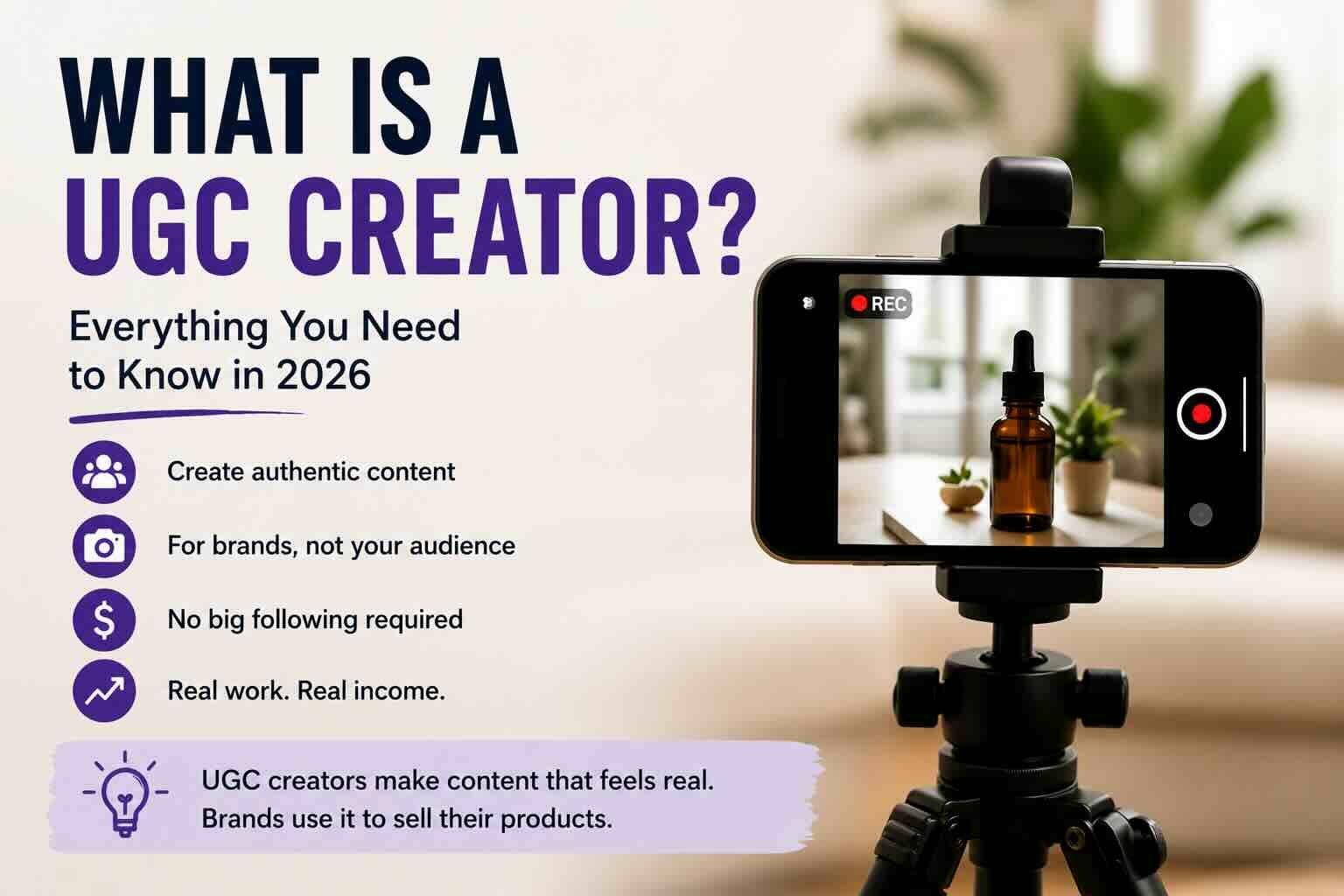
If you've spent any time on TikTok or Instagram in the last couple of years, you've probably seen the term "UGC creator" pop up in someone's bio. Maybe you've wondered what it actually means, or whether it's just a fancier way of saying "influencer." It isn't. UGC creators are a real and distinct category, and the work they do is one of the fastest-growing corners of the creator economy.
I'm going to walk through the whole thing in this post. What UGC actually is, who UGC creators are, how they're different from influencers, what they get paid, how to become one, and what the real day-to-day looks like. By the end, you'll have a clear sense of whether this is a path worth exploring for yourself, or just a corner of the industry you want to understand better.
Let's start at the beginning.
What does UGC mean?
UGC stands for user-generated content. The phrase has been around for years and originally just referred to any content created by regular users instead of a brand or a publisher. A customer review on Amazon is UGC. A TikTok of someone unboxing a package is UGC. An Instagram post tagging a restaurant is UGC. The defining feature was always that it came from the audience, not from a marketing department.
That older definition still applies. But the term has narrowed significantly over the last few years, and now when people say "UGC" in a creator economy context, they're almost always talking about something more specific: content that looks like organic user content but is paid for and made by a creator who specializes in this kind of work.
That's the shift that created the UGC creator role as we know it today.
So what is a UGC creator?
A UGC creator is a content creator who is paid by brands to produce video and photo content that feels authentic and organic, in the style of a regular customer or fan. The content is then used by the brand, not by the creator's own audience.
That last part is important and a little counterintuitive at first, so let me say it again. A UGC creator does not need a big following. They are not posting the content to their own channels (most of the time). The brand pays for the content and then runs it on their own social pages, in their paid ads, on their website, or wherever else they need it.
In other words, a UGC creator is essentially a freelance video and photo producer who specializes in a very specific aesthetic: the "scroll-stopping, authentic, just-a-real-person" look that performs really well in paid social.
This is a meaningful distinction because most people assume creators have to build an audience first before they can earn money. UGC creators have flipped that script. They earn money producing content for brands, not building personal followings.
How is UGC different from influencer marketing?
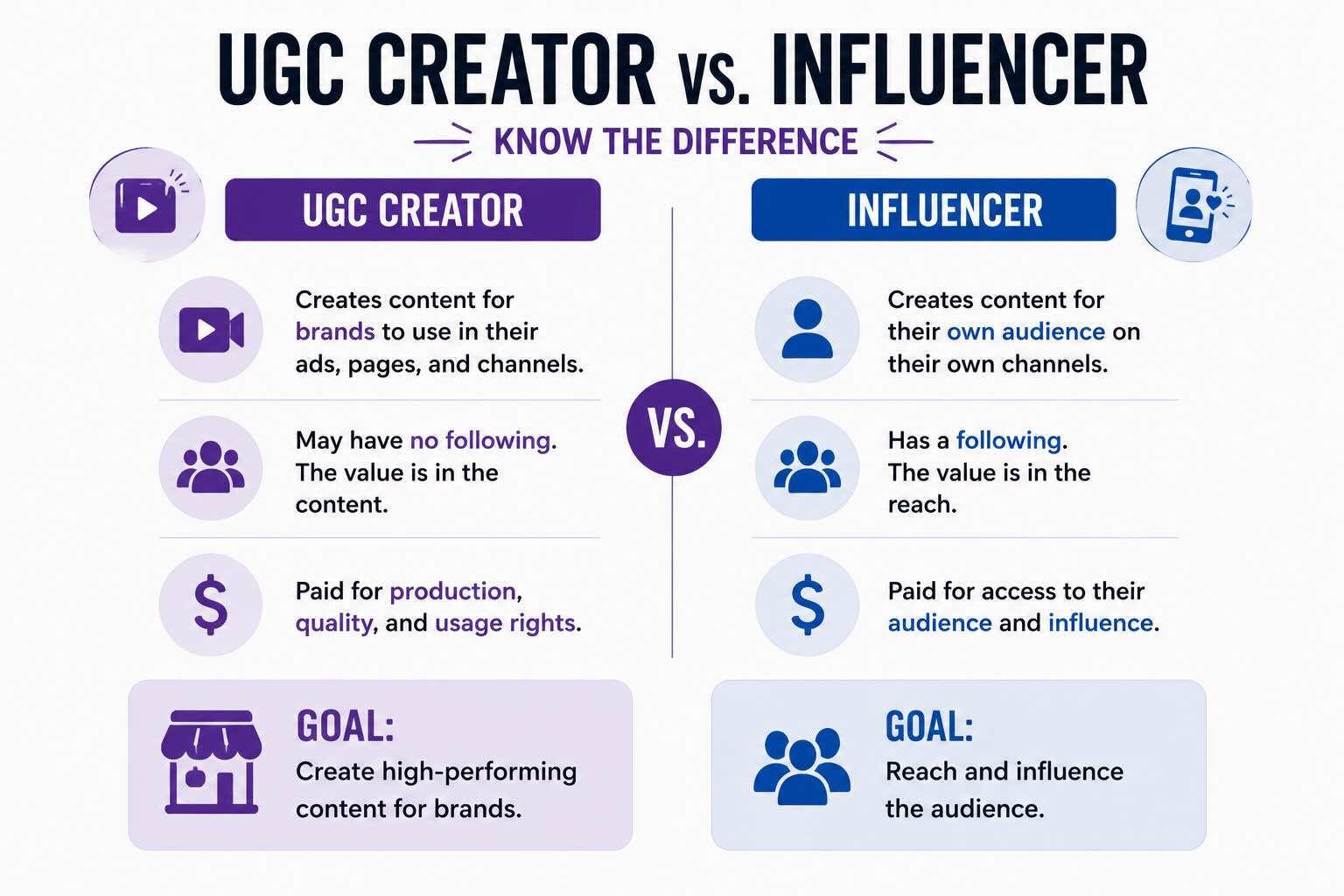
This is the question I get asked most often, so it's worth slowing down on. The two roles overlap a little, but they are structurally different jobs.
An influencer has a following. Brands pay them to post content on their own channels because the brand wants access to that influencer's audience. The value is in the reach.
A UGC creator may or may not have a following. Brands pay them to produce content that the brand then posts (or uses in paid ads) on the brand's own channels. The value is in the content itself, not the creator's reach.
A few specific differences:
- Influencer deals are about distribution. UGC deals are about production.
- Influencer rates scale with follower count and engagement. UGC rates scale with content quality, deliverable scope, and usage rights.
- Influencers can take years to build the kind of following that earns real brand money. UGC creators can start earning within weeks if they're good at making content.
- Influencer content lives on the creator's profile and represents the creator. UGC content lives on the brand's accounts and represents the brand.
Some creators do both. They post to their own channels as an influencer and they also take UGC jobs on the side. There's nothing stopping you from doing both. But they are genuinely two different products that brands buy for two different reasons.
Why brands love UGC

To understand why this whole category exploded, you have to understand what changed in advertising. For decades, brands made polished, expensive, studio-shot ads. They hired ad agencies, booked production crews, paid for actors, and produced commercials that looked like commercials.
Then platforms like TikTok happened. And a strange thing started to happen with paid ads on those platforms: the polished, expensive ones underperformed. The ones that looked like regular user content, shot on a phone in someone's kitchen, outperformed the cinematic ones by huge margins. Sometimes by 5x or more in click-through rate.
Brands figured this out fast. The new playbook became:
- Hire 5 or 10 UGC creators to make 30 or 60 second videos in different styles
- Run them all as paid ads on TikTok and Instagram
- See which ones perform
- Double down on the winners and order more from those creators
That's the entire UGC creator economy in one paragraph. Brands need a constant stream of "authentic-feeling" video content to feed their paid social testing. UGC creators are the supply.
A few specific reasons brands love this:
- It's significantly cheaper than traditional ad production. A UGC video might cost $200 to $800. A traditional studio-shot ad might cost $20,000 or more.
- It's fast. Most UGC creators deliver within a week or two.
- It actually performs. Authentic-feeling content beats polished content in most paid social environments.
- Brands own the content outright. Unlike influencer deals where the content lives on the influencer's page, UGC content belongs to the brand to use however they want.
- It's scalable. A brand can hire 50 UGC creators in a month if they want to. Hiring 50 influencers is a different ballgame.
This is why UGC has gone from a niche side hustle to a real career path for thousands of creators.
Who can become a UGC creator?
This is the part that surprises people. You do not need a big following to be a UGC creator. You do not need to be conventionally photogenic. You do not need expensive equipment. You do not need to be famous on any platform.
What you actually need:
- A smartphone with a decent camera. Almost any phone from the last three or four years works.
- Some natural light or a basic ring light. Good lighting is more important than any other piece of equipment.
- The ability to be on camera comfortably. Not perfectly. Comfortably. UGC works because it feels real.
- An understanding of what brands want. This is the skill that separates UGC creators who book jobs from ones who don't. You have to understand hooks, pacing, and how to make a 30-second video that actually converts.
- A portfolio. Brands want to see your work before they hire you. We'll get into how to build one in a minute.
That's it. There are people earning a full-time income from UGC who have fewer than 1,000 followers across all platforms. The skill is in the content, not the audience.
What kinds of content do UGC creators make?
Most UGC falls into a few standard formats. If you want to understand the work, learn these formats first.
Unboxing videos. A creator opens a package on camera, shows the product, reacts to it, and walks through the experience. These work because they capture the feeling of getting something in the mail, which is hard to fake.
Product demos. The creator uses the product on camera and shows what it does. Skincare creators apply the cream. Cooking creators use the blender. Tech creators set up the gadget.
Testimonials. The creator explains why they love the product, often as a talking-head shot. These feel like a real customer review because, in the best UGC, they basically are.
Problem-solution videos. The creator opens by describing a problem they had, then shows how the product solved it. This is the most common UGC ad format and the one brands ask for most often.
Lifestyle integration. The creator shows the product fitting into their daily life. They drink the protein shake at the gym. They use the planner at their desk. They wear the sunglasses on a walk.
Reaction or comparison videos. Two products side by side, or a "before and after" using a specific product.
Most UGC briefs will ask for some combination of these. Once you've made a few of each, you'll have a flexible toolkit.
What does a UGC creator actually do day-to-day?
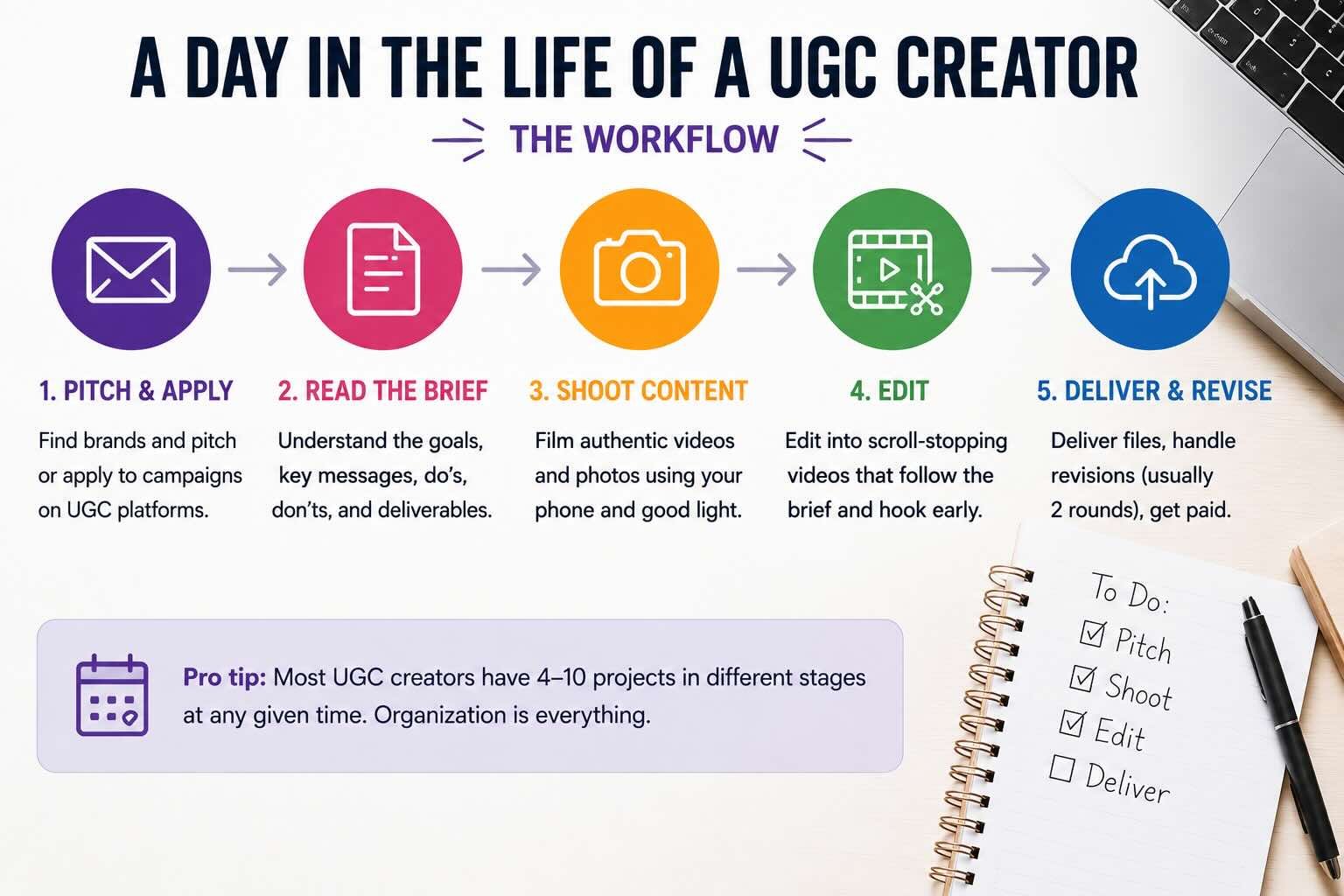
The work breaks down into a few real chunks.
Pitching and applying. Most UGC creators spend a decent amount of time reaching out to brands they want to work with, or applying through UGC platforms like Aspire, Insense, JoinBrands, or directly on a brand's "creator partnerships" page. Pitching is its own skill, and the creators who book the most jobs are typically the ones who pitch the most thoughtfully.
Reading briefs. Every brand sends a brief that explains what they want. Length, format, hook, key messaging points, things to avoid, deliverable count, and usage rights. Reading briefs carefully and following them exactly is the single most important skill in this work. Brands that get exactly what they asked for hire that creator again. Brands that get something close but not quite, often don't.
Shooting. The actual filming is usually a few hours of work, depending on the scope. A simple unboxing might be 30 minutes of setup and shooting. A multi-scene problem-solution video might be a half-day.
Editing. Most UGC is delivered as a fully edited final video. Some brands ask for raw footage so they can edit themselves, but most want the polished version.
Revisions and delivery. Two rounds of revisions is standard. Then final delivery, usually as MP4 files via Google Drive, Frame.io, or Dropbox.
Invoicing and getting paid. Most UGC deals pay net 30 or net 60. The actual payment cycle on UGC work can be slow, which is something to plan around financially.
A solid UGC creator who's doing this full-time will typically have 4 to 10 deliverables in motion at any given time, in different stages.
What do UGC creators get paid?
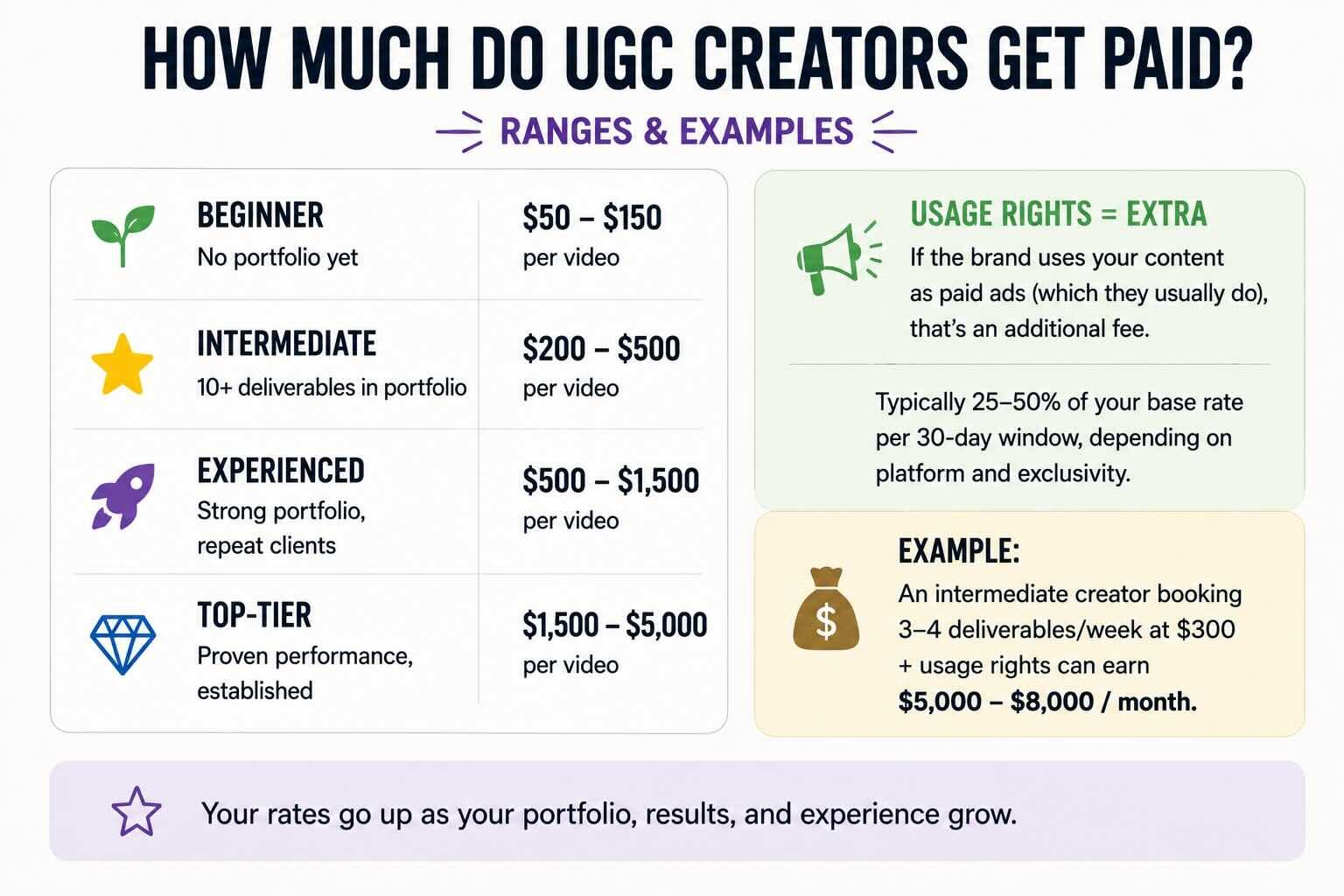
This depends on your experience level, the brand size, the deliverable scope, and the usage rights. Some rough ranges:
- Beginner UGC creator (no portfolio yet): $50 to $150 per video
- Intermediate UGC creator (10+ deliverables in portfolio): $200 to $500 per video
- Experienced UGC creator (strong portfolio, repeat clients): $500 to $1,500 per video
- Top-tier UGC creator (proven performance, established personal brand within UGC): $1,500 to $5,000 per video
Usage rights are a separate line item. If the brand wants to run your content as a paid ad (which they usually do), that's an additional fee on top of the production cost. Usage rights typically add 25 to 50% of your base rate per 30-day window, depending on the platform and exclusivity terms.
To put real numbers on this, an intermediate UGC creator booking three or four deliverables a week at $300 each, plus usage rights, can earn $5,000 to $8,000 a month. That's a legitimate full-time income for someone whose only equipment is a phone and a ring light.
How do you become a UGC creator?
If you read all of the above and you're thinking "ok, I want to try this," here's the actual path. No fluff.
Step 1: Pick a niche. Even though UGC creators don't need a big following, brands still hire by category. A skincare brand wants someone who looks credible talking about skincare. A fitness brand wants someone who can plausibly be a fitness customer. A productivity app wants someone who looks like a busy professional. Pick a niche that fits your actual life, because authenticity is what brands are buying.
Step 2: Build a portfolio of 5 to 10 sample videos. This is the most important step. Pick products you already use and love, and make UGC-style videos about them as if you were already hired. Unboxing, demo, problem-solution, testimonial. Treat these as a portfolio piece, not as content for your followers. You're showing brands what you can do.
Step 3: Set up a simple portfolio site or media kit. A Notion page, a Google Drive folder, or a simple link in bio works. Put your sample videos there, plus a one-paragraph "about me," your niche, your rates, and how to contact you.
Step 4: Sign up for UGC platforms. Aspire, Insense, JoinBrands, Billo, Trend, and Collabstr are all worth exploring. Most are free to join. Apply to a lot of campaigns. Expect a low acceptance rate at first.
Step 5: Pitch directly. Find brands you actually use and like. Email or DM them with a short, specific pitch. Include a link to your portfolio. The script that works is: "Hey [Brand] team, big fan of [specific product]. I create UGC for brands in [your niche], here are a few samples [link]. Would love to make some content for you if there's a fit."
Step 6: Deliver well, every time. This is where most UGC creators fall down. They book the first job and then over-promise or miss the brief. The creators who turn this into a real career are the ones who deliver exactly what was asked for, on time, with one round of polish before submission.
Step 7: Re-pitch repeat clients. A brand that hires you once is significantly more likely to hire you again. Stay in touch. Send a quick check-in 30 days after delivery asking if they need more content.
This is the whole game. There's no secret to it. Brands need a steady stream of authentic-feeling content. If you can make that content reliably, brands will pay you for it.
Common mistakes new UGC creators make
A few patterns worth flagging before you start:
Trying to be an influencer first. A lot of new UGC creators get caught up in trying to grow a following before they start booking jobs. This is backwards. You don't need a following. Start pitching now.
Underpricing yourself permanently. It's fine to start with a low rate to build a portfolio. It's not fine to stay there. Once you have five or ten deliverables under your belt, raise your rates. The brands that won't pay the new rate weren't going to be great clients anyway.
Ignoring usage rights. A lot of new UGC creators sign deals where the brand gets unlimited usage rights for the flat production fee. That's leaving money on the table. Always clarify usage and price it as a separate line item.
Skipping the brief. Reading the brief carefully, asking clarifying questions, and delivering exactly what was asked for is the single biggest predictor of repeat work.
Not building a portfolio site. "DM me for samples" is not a portfolio. Brands want to click a link and see your work in 10 seconds.
Is UGC a real career?
Yes. For real. There are tens of thousands of UGC creators earning real income from this work, and the demand from brands continues to grow as paid social budgets keep expanding. A few honest observations though.
It's not effortless. The good UGC creators are good at making content. They've studied hooks. They've practiced being on camera. They've gotten faster at editing. They've learned how to read a brief and deliver against it. The romanticized version of UGC ("just film yourself with your phone and get paid") leaves out the fact that the people making real money have actually gotten good at the craft.
It's also not a guaranteed path. Some creators book a steady stream of work within a few months. Others spend six months pitching and only land a handful of deliverables. The variable is mostly the quality of the portfolio and the consistency of the outreach.
But for anyone who likes making content, doesn't want to wait years to build an audience, and is willing to treat this like a real freelance business, UGC is one of the most accessible income paths in the creator economy right now.
What's next
If you're considering this seriously, the most useful next step is to just make one video. Pick a product you already own. Make an unboxing video, a demo, or a 30-second problem-solution piece. Try to make it feel real, like you're talking to a friend. Watch it back, see what's working and what isn't, and make another one.
Five videos in, you'll have a portfolio. Ten videos in, you'll have a real sense of whether this work is for you. And if it is, the rest is just a matter of pitching, delivering, and getting better one project at a time.
That's the honest version. No hacks, no shortcuts, no $97 course required. UGC is real work, the demand is real, and the door is genuinely open.