Influencer Rate Cards: How to Build One That Actually Lands Deals (2026)
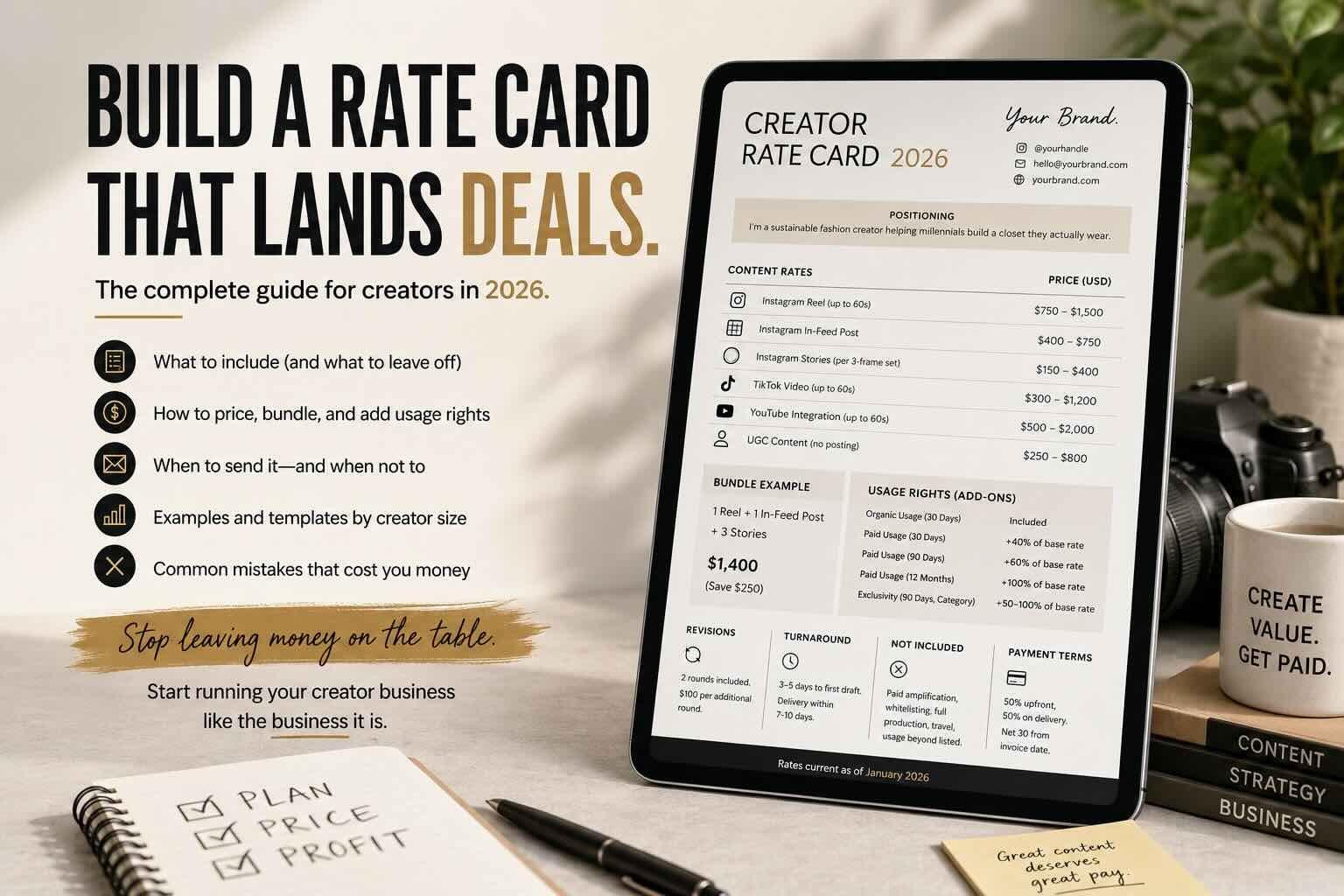
Most creators I talk to have one of two problems with their influencer rate card. Either they don't have one at all, or they have one that's quietly costing them money every time they send it.
I want to fix both of those things in this post.
A rate card sounds like a small thing. It's a one-pager, maybe two. But it's the document that decides how much money you make from a brand deal, whether the brand takes you seriously, and how often you get ghosted after a "what's your rate?" email. Most creators treat it like a pricing sheet. The good ones treat it like a sales tool.
This is a complete guide to building a creator rate card that actually lands deals in 2026. What goes on it, what stays off, when to send it, and the small structural things that separate a rate card brands respond to from one they delete.
What is a rate card, exactly?
A creator rate card (sometimes called a content creator rate card, influencer rate card, or just a rate sheet) is a structured document that lists what you charge for each type of content you produce. Think of it as the menu at a restaurant. The brand can see what's on offer, what each thing costs, and decide what they want to order.
It is not the same as a media kit. A media kit is the pitch. It tells a brand who you are, who follows you, what you've made, and why you're worth working with. A rate card is the price list. The two documents serve different purposes and ideally don't live in the same file. I wrote a separate complete guide to influencer media kits if you want to get that side of your pitch right first. Media kit gets you in the door. Rate card moves the conversation forward.
Do you actually need a rate card?
Short answer: yes, if you've been paid for a brand deal even once.
The longer answer is that the moment a brand says "what's your rate?" and you respond by making it up on the fly in an email, you've already lost some of the deal. You'll quote slightly differently every time. You'll forget to charge for usage rights. You'll undercharge on one deliverable and overcharge on another. You'll sound like you're guessing, because you are.
A rate card forces you to do the pricing work once, in advance, when you're calm. Then you send the same document every time. That's not just easier, it's how you get taken seriously.
When to send the rate card (and when not to)
This is the question that trips up most creators. The honest answer:
Send the rate card AFTER the brand has expressed real interest. Not in the initial DM. Not in the cold pitch. Not attached to your media kit. The order is:
- Pitch or warm intro
- Media kit
- Brand says "we're interested, what would this cost?"
- THEN you send the rate card
If you lead with the rate card, you anchor every conversation to that number. Sometimes the brand had a bigger budget than your rate, and you just told them to spend less. Sometimes the brand was a "no" before they even saw your work, and you just gave them an easy way to filter you out without ever opening your media kit.
The rate card is the document that closes the deal. The media kit is the document that opens it. Treat them differently. We covered the strategy of pricing in depth here if you want to dig into the actual numbers before you build the card itself.
What goes on an influencer rate card
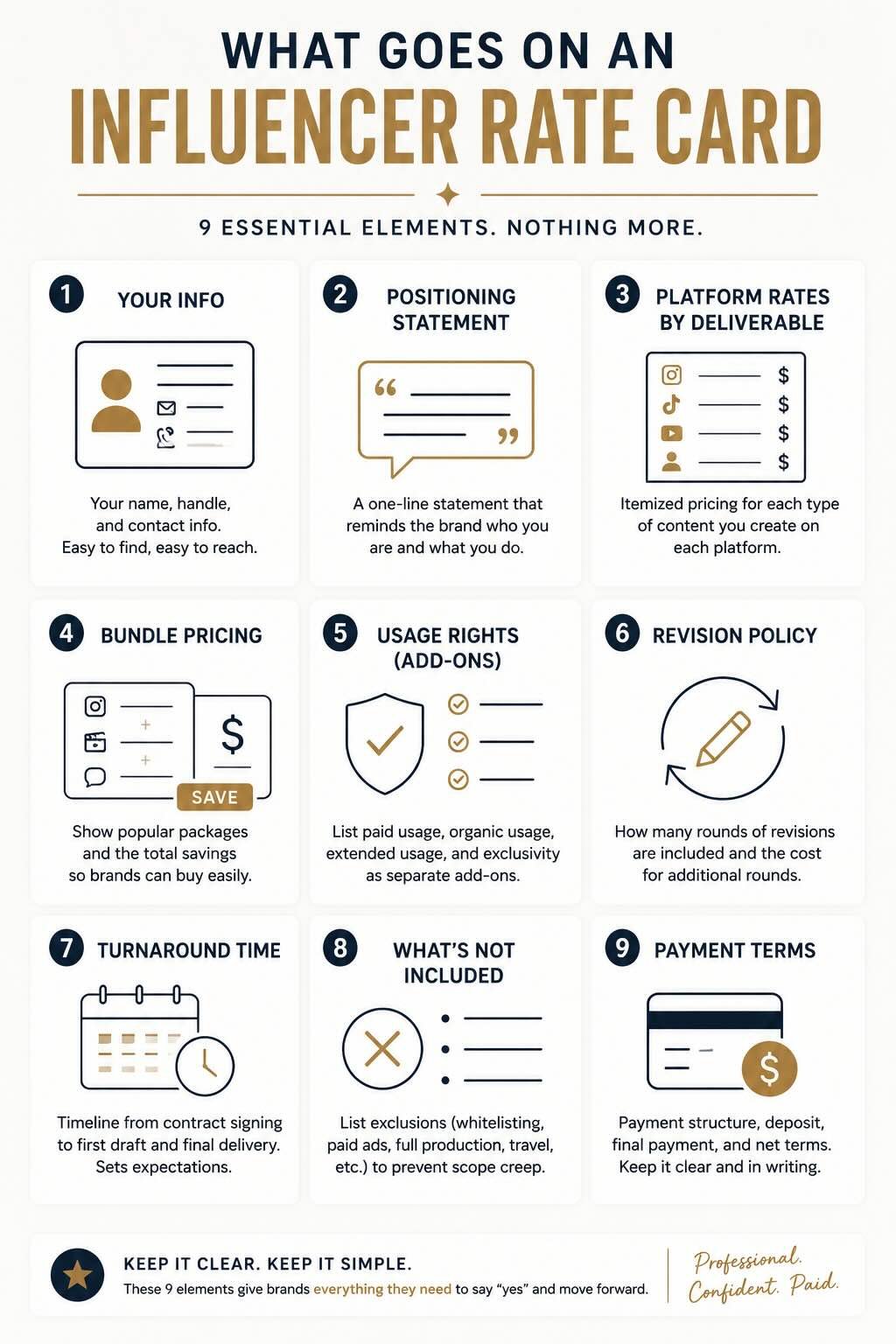
Here's the short list. Every rate card should have these elements and ideally not many more:
1. Your name, handle, and contact info. Top of the page. Don't make brands hunt for how to reach you.
2. A one-line positioning statement. Same one from your media kit. "I'm a sustainable fashion creator helping millennials build a closet they actually wear." Anchors the brand in who you are before they look at numbers.
3. Platform rates, itemized by deliverable. This is the core of the card. Instagram Reel, Instagram in-feed post, Instagram Stories (per frame), TikTok video, YouTube long-form dedicated, YouTube integration, UGC delivery. Whatever you actually offer. Each with a price.
4. Bundle pricing. Most brands buy packages, not single posts. "1 Reel + 3 Stories + 1 carousel = $X." Show the bundle and show the math so they can see the savings.
5. Usage rights as a separate line item. This is where creators lose the most money. Paid usage rights, organic usage rights, extended usage windows, and exclusivity should all be listed as add-ons, not bundled into your base rate. Brands will quietly assume "perpetual rights" come with the base price unless you tell them otherwise. Tell them otherwise.
6. Revision policy. Two rounds included. Anything beyond that is $X per round. Put it on the card so it's not a fight later.
7. Turnaround time. How long from contract signing to first draft. How long for delivery. Sets expectations and protects your weekends.
8. What's NOT included. This sounds counterintuitive, but listing what's not included (white-listing, paid amplification, full production with location/crew, etc.) prevents scope creep before it starts.
9. Payment terms. 50% up front, 50% on delivery is the most common structure. Net 30 from invoice date. Whatever your terms are, put them in writing.
That's the entire rate card. Eight to nine elements on one page (or two if your platform mix is wide). Anything else is decoration.
What to leave off your rate card
Most rate cards I see online are bloated with stuff that doesn't help you close the deal. Cut all of this:
- Your follower count and demographics. Those belong on the media kit, not the rate card. Pricing should be defended by quality, not by audience size.
- Long marketing copy about your "approach" or "philosophy." The rate card is a price list, not an essay.
- Logos of every brand you've ever worked with. One row of three on the media kit is enough. Leave the rate card clean.
- Every social link you've ever owned. Top contact only.
- A QR code for some reason. I see this constantly and I have no idea why.
The cleaner the rate card, the more it reads like a professional document and not a Canva template. Brands subconsciously associate visual restraint with experience.
Influencer rate card examples by creator size
These are illustrative ranges, not promises. Your actual rates depend on engagement, niche, and the five factors I broke down in the pricing guide. Use these as starting points.
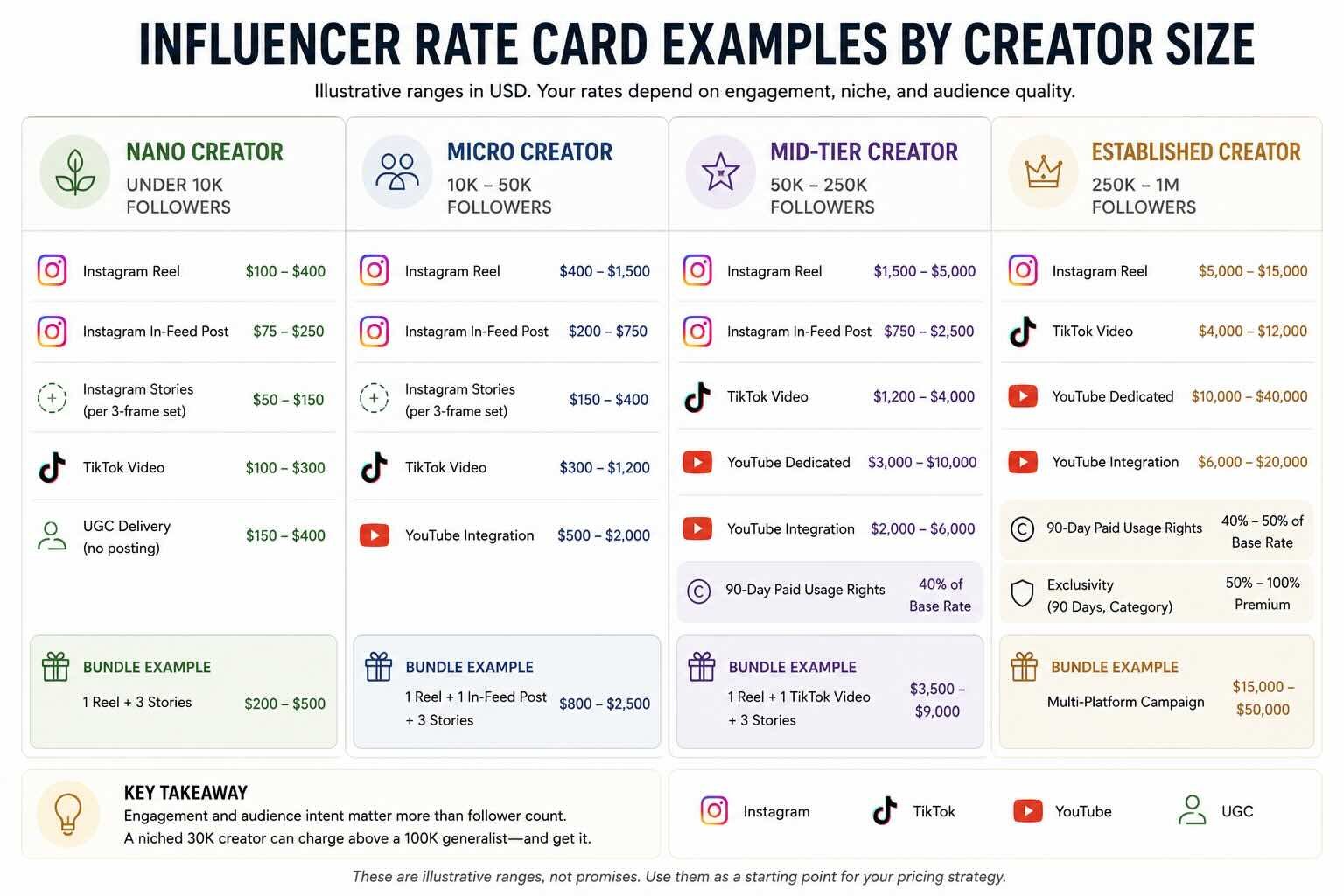
Nano creator rate card (under 10K followers)
- Instagram Reel: $100 to $400
- Instagram in-feed post: $75 to $250
- Instagram Stories (per 3-frame set): $50 to $150
- TikTok video: $100 to $300
- UGC delivery (no posting): $150 to $400
- Bundle (1 Reel + 3 Stories): $200 to $500
Micro creator rate card (10K to 50K followers)
- Instagram Reel: $400 to $1,500
- Instagram in-feed post: $200 to $750
- Instagram Stories (per 3-frame set): $150 to $400
- TikTok video: $300 to $1,200
- YouTube integration: $500 to $2,000
- Bundle (1 Reel + 1 in-feed + 3 Stories): $800 to $2,500
Mid-tier creator rate card (50K to 250K followers)
- Instagram Reel: $1,500 to $5,000
- Instagram in-feed post: $750 to $2,500
- TikTok video: $1,200 to $4,000
- YouTube dedicated: $3,000 to $10,000
- YouTube integration: $2,000 to $6,000
- 90-day paid usage rights: 40% of base rate
- Bundle (1 Reel + 1 TikTok + 3 Stories): $3,500 to $9,000
Established creator rate card (250K to 1M followers)
- Instagram Reel: $5,000 to $15,000
- TikTok video: $4,000 to $12,000
- YouTube dedicated: $10,000 to $40,000
- YouTube integration: $6,000 to $20,000
- 90-day paid usage rights: 40 to 50% of base rate
- Exclusivity (90 days, category): 50 to 100% premium
- Bundle (multi-platform campaign): $15,000 to $50,000
Note that these ranges have huge variance. A niched 30K finance creator can charge above a 100K generalist lifestyle creator and get it. Engagement and audience intent matter more than follower count, and your rate card should reflect what your specific audience is worth, not the platform average.
How to format your rate card
A few things that separate a rate card that lands deals from one that gets deleted:
Use one page if you can, two maximum. Brands open a PDF, scan for the relevant deliverable, and decide if they can afford you in about 30 seconds. Make that easy.
Use clear sections with white space. Resist the urge to fill every inch. Negative space reads as confidence.
Lead with your highest-margin deliverable. Whatever makes you the most per hour of work, list it first. Anchors the brand to your strongest offering.
Use real numbers, not "starting at." "Starting at $500" signals you're flexible to negotiate down. "$750 to $1,000" gives you a range to work within while still anchoring the conversation in the right zone.
Date the document. A small footer like "Rates current as of January 2026" tells the brand the document is fresh and gives you a reason to raise rates the next time you update it.
Match the visual identity of your media kit. Same fonts, same color palette, same logo. The two documents should feel like they came from the same creator.
Common rate card mistakes
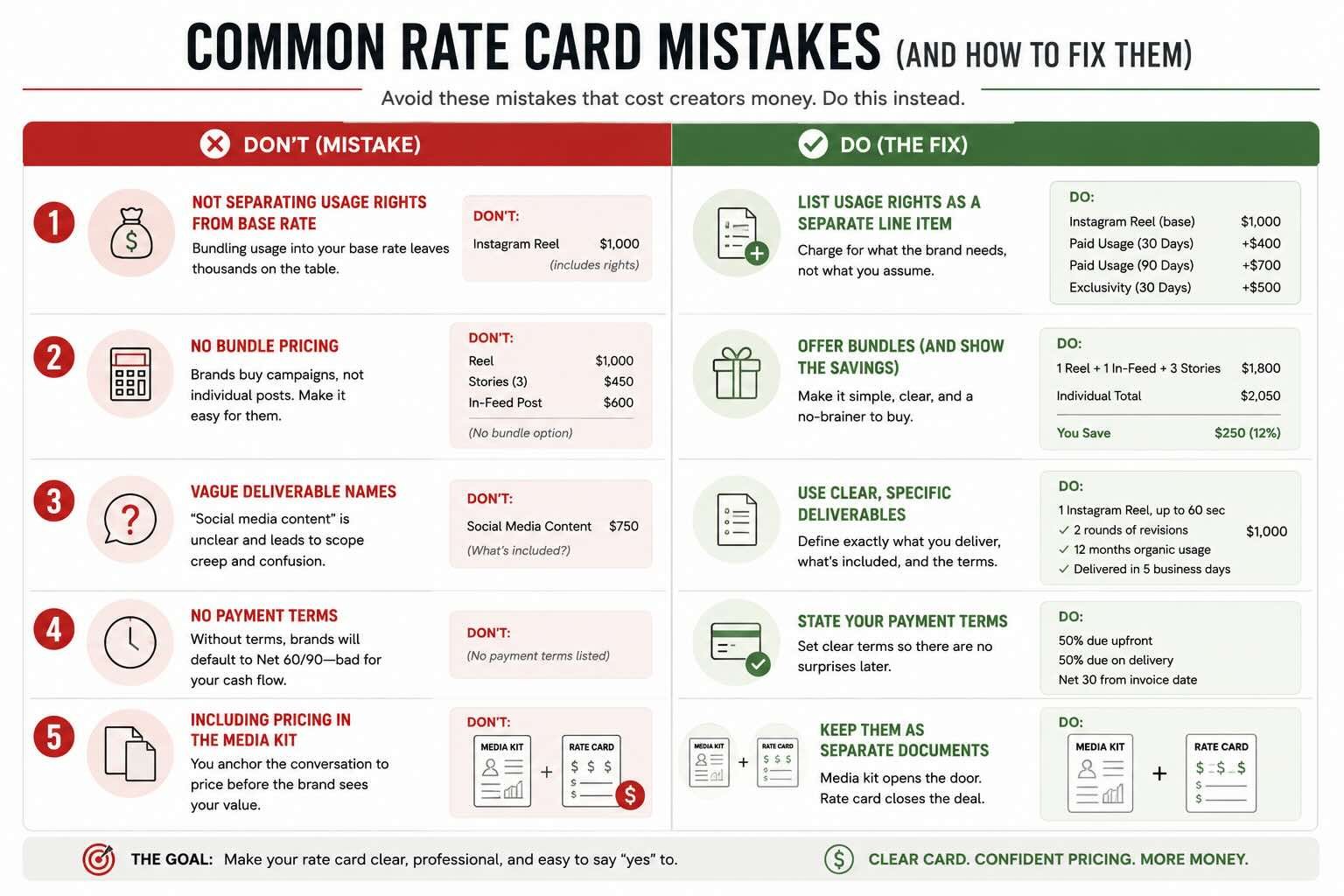
The five mistakes I see most often, in order of how much money they cost:
- Not separating usage rights from base rate. Single biggest source of underpayment. Always a separate line item.
- No bundle pricing. Brands buy campaigns, not posts. If your card only lists individual rates, you're forcing them to do math you should be doing for them.
- Vague deliverable names. "Social media content" is not a deliverable. "1 Instagram Reel, 60 seconds, 2 rounds of revisions, 12 months organic usage" is a deliverable.
- No payment terms. If your contract is silent on payment terms, brands will default to net 60 or net 90, which is industry standard and brutal on creator cash flow. Put your terms on the rate card.
- Including pricing in the media kit itself. Splits your pitch in half. The brand sees the number before they've fallen in love with your work. Keep them as separate documents.
How often to update your rate card
At minimum, every quarter. Ideally every month if your engagement is shifting.
The reason is the same reason your media kit needs to stay current. A rate card from six months ago is based on six-month-old data. Your follower count is different. Your engagement is different. The brands you've worked with are different. If you've grown 20% in the last quarter and you're still sending last quarter's card, you're charging last quarter's rates. Forever.
Set a recurring reminder. Or have your Trovio agent handle this for you, keep your rate card updated as your engagement shifts, and adjust your rates as you grow. Either way, the principle is the same: a stale rate card costs you money every time you send it.
The takeaway
A great influencer rate card isn't a long document. It's a clear one. It tells a brand what you offer, what it costs, what's included, what's not, and how to pay you. Everything else is decoration.
If you've been pricing every deal from scratch in your inbox, today's the day to build the card. Open a doc, list your deliverables, set your prices, and add the usage rights line items. You can have a working draft in an hour.
And remember: the rate card is one half of the pitch. The media kit is the other half. If you haven't built the media kit yet, here's the complete guide to influencer media kits. And if you want to dig into the actual math of setting your rates before you build the card, here's the full pricing guide.
The point of all three documents is the same: stop leaving money on the table, and start running your creator business like the business it actually is.