How Many Followers Do You Need to Monetize Instagram?

You don't need a huge following to start earning on Instagram. You need the right strategy for your size.
Ask this question in any creator community and you'll get ten different answers, half of them outdated. So let's settle it with the actual numbers, because the real answer is more encouraging than most people think.
The short answer: Instagram's native monetization tools have different thresholds: you need around 10,000 followers for Subscriptions and Live Badges, 500 followers to receive Gifts on Reels, and Bonuses are invite-only with no public threshold. But brand deals, UGC work, and affiliate marketing have no follower minimum at all, and that's where most creator income actually comes from.
Let's break down each path.
Instagram's Built-In Monetization Tools (and Their Follower Requirements)
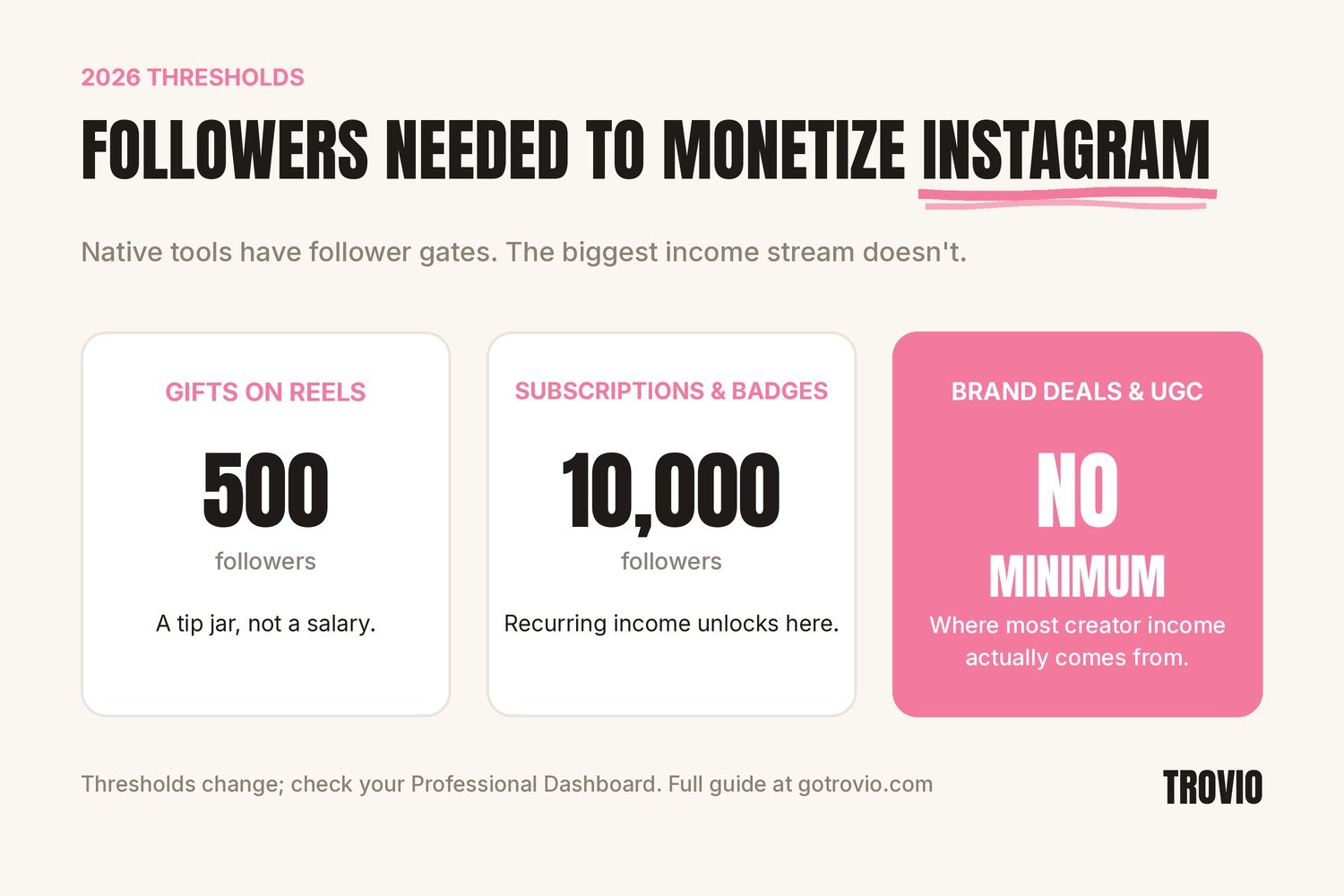
Instagram's native tools have follower gates. Brand deals don't.
First, the baseline for everything: you need a professional account (Creator or Business), you need to be 18 or older, you need to be in an eligible country, and your account has to comply with Instagram's monetization policies. No bought followers, no engagement bots, no policy strikes. Pass that checklist and here's what unlocks at each level:
Gifts on Reels: ~500 followers. Viewers send virtual gifts on your Reels that convert to real money. The bar is low, but so is the income. Think of it as a tip jar, not a salary.
Subscriptions: ~10,000 followers. Your most loyal followers pay a monthly fee ($0.99 to $99.99) for exclusive content, badges, and perks. This is Instagram's most reliable native revenue tool, basically a built-in Patreon, and 10K is the gate.
Live Badges: ~10,000 followers. Fans buy badges during your live streams to support you in real time. Same threshold as Subscriptions.
Bonuses: invite-only. The old Creator Fund is gone. Instagram replaced it with invite-only bonus programs that pay for Reels performance. There's no follower number you can grind toward here; Instagram picks accounts based on engagement and content quality. Don't build a plan around it.
One honest caveat: Instagram adjusts these thresholds and eligible regions regularly, so check your own Professional Dashboard → Monetization to see exactly what your account qualifies for today. If the option appears, you're eligible. That's the ground truth.
The Path With No Follower Minimum (Where the Real Money Is)
Here's what the follower-threshold conversation misses: the platforms' native tools are the smallest slice of creator income. Brand partnerships are the biggest, and brands don't have a follower requirement. They have a "can this person make content that sells" requirement.
That's not a consolation prize for small accounts. It's the actual market:
Brand deals. Brands increasingly want creators with engaged niche audiences over big detached ones, and creators of all sizes are landing paid partnerships. If you want the playbook, here's our full guide on how to get brand deals as a creator.
UGC work. UGC flips the model entirely: brands pay you for content they post on their channels, so your follower count is nearly irrelevant. Creators with a few hundred followers do paid UGC work every day. Here's where to find UGC jobs and what they pay.
Affiliate marketing. Commission on sales through your links. No minimum, no application, just an audience that trusts your recommendations.
This is exactly the gap Trovio was built for. The agency model only represents creators big enough to generate commission, which leaves everyone else pitching brands alone. Trovio does the agent work (finding brand fits, building your media kit, pitching) for creators of all sizes, and because it's not taking a percentage, you keep 100% of what you earn from brand partnerships.
So What Should You Actually Aim For?
If you're under 500 followers: skip the native tools entirely for now. Build a content portfolio and start UGC pitching, because that pays today.
If you're between 500 and 10K: Gifts are unlocked but won't move the needle. Your leverage is engagement rate; a 5K account with strong engagement out-earns a 50K account with a dead audience on brand deals. Know what to charge and start pitching.
If you're past 10K: turn on Subscriptions and Live Badges as a baseline layer, but treat them as the floor. Brand partnerships should still be the main event.
And whatever your size, the follower count you have right now is enough to start earning something. The creators who wait for a magic number stay unpaid the longest.
Instagram Monetization FAQ
Can you make money on Instagram with 1,000 followers? Yes. You won't qualify for Subscriptions, but brand deals, UGC work, and affiliate marketing have no follower minimum, and nano creators land paid partnerships regularly.
How many followers do you need for Instagram Subscriptions? Around 10,000, plus a professional account, age 18+, and an eligible country. Check your Professional Dashboard to confirm your account's status.
Does Instagram pay you directly for views? Not by default. The original Creator Fund no longer exists; performance-based Bonuses are invite-only. Most direct platform income comes from Gifts, Badges, and Subscriptions.
What matters more than followers for making money? Engagement rate and niche. Brands pay for audiences that act, not audiences that scroll past.
The Bottom Line
The follower thresholds are real, but they only gate Instagram's smallest income streams. The biggest one, brand partnerships, has no gate at all except the quality of your content and the consistency of your pitching. So stop waiting for a number. Start where you are.
Want help finding the brands and making the pitch? That's what Trovio does. Or email me anytime at andrew@gotrovio.com