Engagement Rate Calculator: Free Tool, Formula, and Benchmarks
Every brand that's ever considered paying a creator asks some version of the same question: not "how many followers do you have," but "does your audience actually care." Engagement rate is the number that answers it. It's also the number that quietly sets your rate, gets you onto brand shortlists, and decides whether a pitch turns into a paycheck.
The problem is that nobody agrees on what counts as good, half the calculators online give you a different number for the same post, and the benchmarks float around without much context. So this is the straight version: what engagement rate is, the exact formula, how to calculate yours in about a minute (there's a free calculator below), and what actually counts as a strong rate on Instagram and TikTok in 2026.
What is engagement rate?
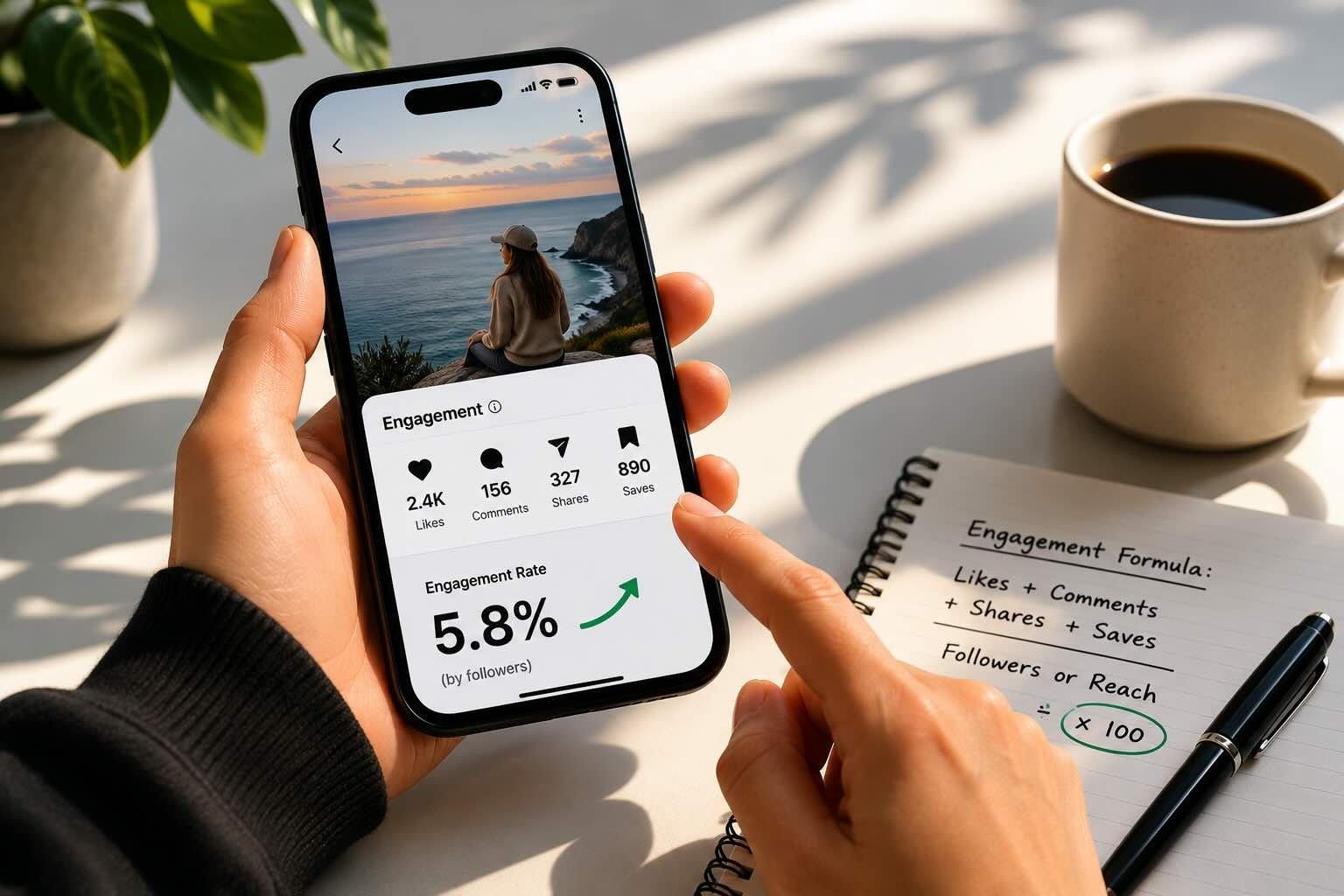
Engagement rate is the percentage of people who interact with your content, measured against either your audience size or how many people saw it. Interactions usually means likes, comments, shares, and saves.
The reason brands lean on it instead of follower count is simple: followers are easy to inflate and easy to fake, but engagement is hard to manufacture. A creator with 8,000 followers and a 6 percent engagement rate often delivers more real attention for a brand than someone with 80,000 followers sitting at 0.8 percent. Engagement rate is the closest single number to "this audience trusts this person."
It's worth knowing up front: there's no one official formula. The number changes depending on what you divide by (followers vs. reach) and which interactions you count. That's why two calculators can hand you two different answers. Below I'll show you both common methods so you know exactly what you're looking at.
The engagement rate formula
There are two standard ways to calculate it, and they answer slightly different questions.
By followers (the most common, and what most brands and media kits use):
Engagement rate = (likes + comments + shares + saves) / followers x 100This tells you how engaged your overall audience is. It's the version you'll usually put on your media kit because it's easy for a brand to verify against your public follower count.
By reach or views (the more accurate version of how a specific post performed):
Engagement rate = (likes + comments + shares + saves) / reach x 100This tells you how compelling a piece of content was to the people who actually saw it. It's often higher than the by-followers number, because reach is usually smaller than your total following. Use this when you want to show how hard a specific post worked.
A platform note: on TikTok, engagement is frequently measured against views rather than followers, because reach on TikTok is so decoupled from follower count. So a TikTok engagement rate by views uses the same idea: total interactions divided by views, times 100.
If you're putting a number on your media kit or rate card, use the by-followers method and label it clearly. Brands like knowing which method they're looking at.
How to calculate your engagement rate, step by step
Here's the by-followers method with real numbers.
Instagram example:
Followers: 12,000
A recent post got: 540 likes, 32 comments, 18 shares, 60 saves
Total engagements: 540 + 32 + 18 + 60 = 650
650 / 12,000 = 0.054
Times 100 = 5.4 percent engagement rate
For a more representative number, do this across your last 9 to 12 posts and average them. One viral post or one flop can skew a single-post reading.
TikTok example (by views):
A video got 90,000 views, 7,200 likes, 140 comments, 310 shares
Total engagements: 7,200 + 140 + 310 = 7,650
7,650 / 90,000 = 0.085
Times 100 = 8.5 percent engagement rate
If math by hand isn't your thing, the calculator below does it for you.
Free engagement rate calculator
Enter your numbers and it does the rest. Pick whether you're measuring against followers (your overall audience) or reach/views (a specific post).
Engagement Rate Calculator
Once it's in, run it across a handful of recent posts and average the results for the most honest number.
What is a good engagement rate?
Here's where most articles wave their hands. The honest answer is that "good" depends on your platform, your follower count, and your niche, but real benchmarks do exist. These are by-followers ranges that hold up well as of 2026.
Instagram (engagement rate by followers):
- Under 10K followers (nano): 4 to 8 percent is common, and small, tight-knit niches can run higher.
- 10K to 50K (micro): 2 to 4 percent.
- 50K to 500K (mid): 1.5 to 3 percent.
- 500K and up (large): 1 to 2 percent.
As a quick gut check on Instagram: under 1 percent is low, 1 to 3 percent is around average, 3 to 6 percent is strong, and 6 percent or higher is excellent, especially as your account grows.
TikTok runs higher than Instagram across the board, partly because reach isn't tied to follower count. Measured by followers, a good TikTok engagement rate often lands in the 4 to 8 percent range and can climb well past that for smaller accounts. Measured by views, healthy videos commonly sit in the high single digits and up.
Two honest caveats. First, engagement rate naturally falls as you grow. A 2 percent rate at 400K followers can be more impressive than 6 percent at 3K, so don't panic when the number drops as your audience scales. Second, niche matters a lot. A tight community (think a specific hobby, sport, or interest) will out-engage a broad lifestyle account every time. Compare yourself to creators in your lane, not to the whole platform.
Why your engagement rate matters for brand deal

This is the part that turns a vanity metric into money. When a brand evaluates you, engagement rate is one of the first things they check, because it predicts whether their campaign will actually drive results. A strong rate is leverage. It's the reason a smaller creator can charge mid-tier rates and win deals over accounts ten times their size.
So your engagement rate should show up in three places:
- Yourmedia kit: front and center, clearly labeled, ideally as an average across recent posts.
- Yourrate card: it's the justification for your price. A 5 percent rate backs up a higher number than a 1 percent rate at the same follower count.
- Yourpitches: one line, early. "My audience is small but highly engaged at 6 percent" reframes the whole conversation away from follower count.
If you're negotiating the deal itself, knowing your worth on paper also helps you hold your rate when the contract terms come around.
How to improve your engagement rate
A few things that move the number more than anything else:
- Post for saves and shares, not just likes. Saves and shares weigh heavily and signal real value. "Save this for later" content (tips, lists, how-tos) outperforms.
- Ask one specific question in your caption or first comment. Generic "thoughts?" gets ignored. A concrete either-or question gets replies.
- Reply to every comment in the first hour. Early engagement tells the algorithm to push the post, and it genuinely builds community.
- Cut the dead weight. If certain post types consistently underperform, stop making them. A smaller, more consistent set of formats usually lifts your average.
- Tighten your niche. The more clearly your account is about one thing, the more the right people engage and the fewer passive followers drag your rate down.
Where Trovio fits
Calculating your rate is step one. Knowing what to do with it (which posts to make more of, what to put on your media kit, how to turn a strong rate into a higher price) is the work an agent used to do for the top 1 percent of creators and almost nobody else. That gap was never about creators not caring. The agency commission model just only ever made it worth serving the biggest accounts.
That's what Trovio is built to close. Our Post Analyzer reads your content performance and shows you what's working and what to lean into, and Trovio handles the agent-level work around it: brand matching, your media kit, rate guidance, and managing the deal. Trovio is built for creators of every size, and it never takes a percentage of your brand partnerships. You keep 100 percent of what you earn. The brands pay Trovio, not you.
Your next step
Run your last handful of posts through the calculator above, average them, and put that number on your media kit. Then compare it to the benchmarks here so you know how to frame it. A clear, honest engagement rate is one of the most useful things a creator can carry into a brand conversation.
And if you'd rather have the analysis, the media kit, and the brand outreach handled for you, that's exactly what Trovio does, for creators of every size, without ever taking a cut.
Start free at gotrovio.com.
Andrew Lukas is co-founder and CEO of Trovio. andrew@gotrovio.com