Influencer Contracts: How to Read One Before You Sign (Free Template Inside)
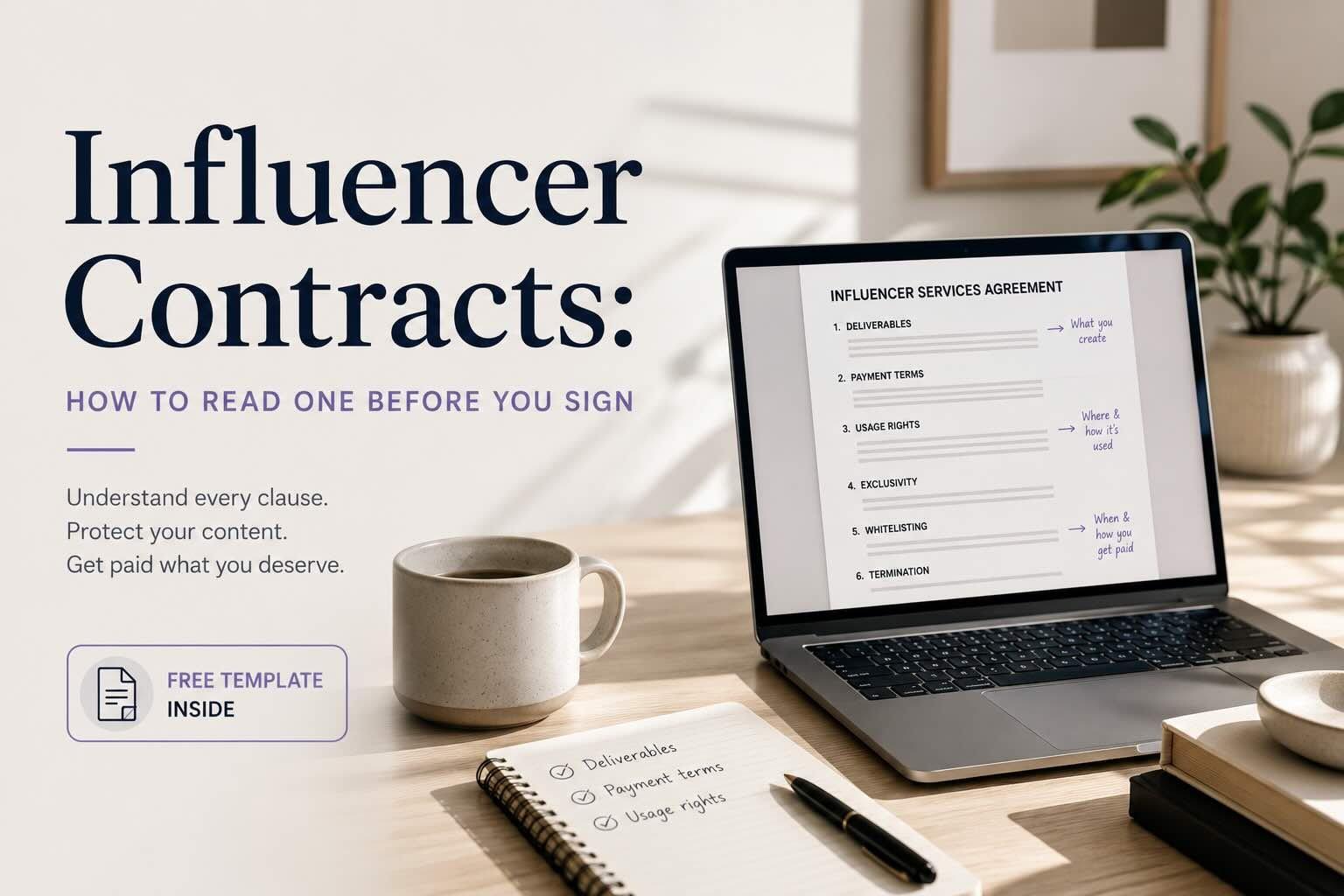
You did the hard part. You found the brand, you pitched, you agreed on a number. Then a PDF lands in your inbox titled "Influencer Services Agreement," it's three pages of dense language, and the brand wants it signed by Friday. So you skim it, sign it, and hope for the best.
That moment is where a lot of creators quietly lose money. Not on the rate, but on the terms buried under it: who owns the content, how long the brand can run it as ads, what you're not allowed to post next month, and when you actually get paid.
This is a plain-language guide to reading an influencer contract before you sign it. What every clause means, which ones cost you money if you ignore them, what to push back on, and a free template you can copy. No legalese, no scare tactics. Just the stuff a good agent would walk you through, written down so you can do it yourself.
One honest note up front: I'm not a lawyer, and nothing here is legal advice. For a big deal, paying a lawyer for an hour of their time is worth it. But for the everyday brand deals most creators are signing, understanding the contract yourself is the difference between getting fairly paid and getting quietly taken advantage of.
What is an influencer contract?
An influencer contract is the written agreement between you and a brand (or its agency) that spells out what you're creating, what you're getting paid, and what rights each side has. You'll see it called a lot of different names, and they mostly mean the same thing:
- Influencer agreement or influencer marketing contract: the catch-all term for a creator-brand deal.
- Sponsorship contract: usually used when the brand is sponsoring a specific piece of content, an episode, or an event.
- Statement of work (SOW): the deliverables-and-deadline part, often attached to a larger master agreement.
- UGC contract: a specific kind of deal where you make content for the brand to use on their channels, not yours. More on that below, because the terms work differently.
Whatever it's titled, the job is the same: protect both sides and remove the "wait, I thought we agreed on..." conversations later. A contract is not a sign the brand doesn't trust you. It's the normal way real partnerships work, and signing one (instead of working off a DM handshake) is a sign you're operating like a business.
If you've never used one, you don't need a 12-page document. A clear one-page agreement covering deliverables, payment, and rights protects you for the vast majority of deals. There's a free template at the bottom of this post.
The anatomy of an influencer contract, clause by clause
Here's what you'll actually find in a typical creator contract, and what each part is really saying. Read these in the order a brand's contract usually lists them.
Parties and term. Who's signing (you, legally, and the brand entity) and how long the agreement lasts. Quick check: make sure your name or business name is correct, because that's who's on the hook.
Scope and deliverables. The exact content you're making. This should be specific: "two Instagram Reels, one carousel post, three stories," not "social content." Vague scope is how a one-post deal turns into five posts for the same money. If it isn't written here, you don't owe it.
Timeline and revisions. Due dates for drafts and final posts, plus how many rounds of edits the brand gets. Cap the revisions. "Up to two rounds of revisions" protects you from a brand that wants endless tweaks on a flat fee.
Payment terms. The number matters, but so does the timing. Look for: the total fee, the payment schedule (deposit up front is ideal), and the payment window. "Net 30" means they pay within 30 days of invoice. "Net 60" means you might be waiting two months, so price that delay in. If you're not sure what to charge before you get here, start with our pricing guide and a clean rate card.
Kill fee. What you get paid if the brand cancels after you've started. A fair contract pays you something (often 25 to 50 percent) if they pull out after work has begun. If there's no kill fee, you're carrying all the risk.
Usage rights. How and where the brand can use your content, and for how long. This is the single most expensive clause to overlook, so it gets its own section below.
Exclusivity. Whether you're barred from working with competing brands, and for how long. A skincare brand might ask you not to post for any other skincare company for 30, 60, or 90 days. That restriction has real value, because it costs you other deals, so it should cost the brand more to ask for it.
Whitelisting and paid amplification. Whether the brand can run ads through or against your content. Also its own section below, because creators give this away for free constantly.
Approvals and FTC disclosure. The brand's right to approve content before it goes live, and the requirement that you label the post as an ad (#ad, "paid partnership," etc.). The disclosure part isn't optional. It's the law in the US, and it protects you as much as the brand.
Termination. How either side can exit the deal and what happens to payment if they do. Watch for one-sided clauses that let the brand walk away owing nothing while you've already shot the content.
Intellectual property and ownership. Who owns the content after it's made. By default, you created it, so you own the copyright unless you sign it away. A lot of contracts quietly transfer full ownership to the brand forever. You usually don't need to give that up, and you can often grant a license instead (see usage rights).
Indemnification and liability. The "if something goes wrong, who pays" section. It's normal, but watch for language that makes you responsible for things outside your control. You're responsible for your content being honest and disclosed, not for the brand's product being defective.
Independent contractor status. Confirms you're not an employee, which affects your taxes. Standard and fine.
Usage rights: the clause that quietly costs creators the most
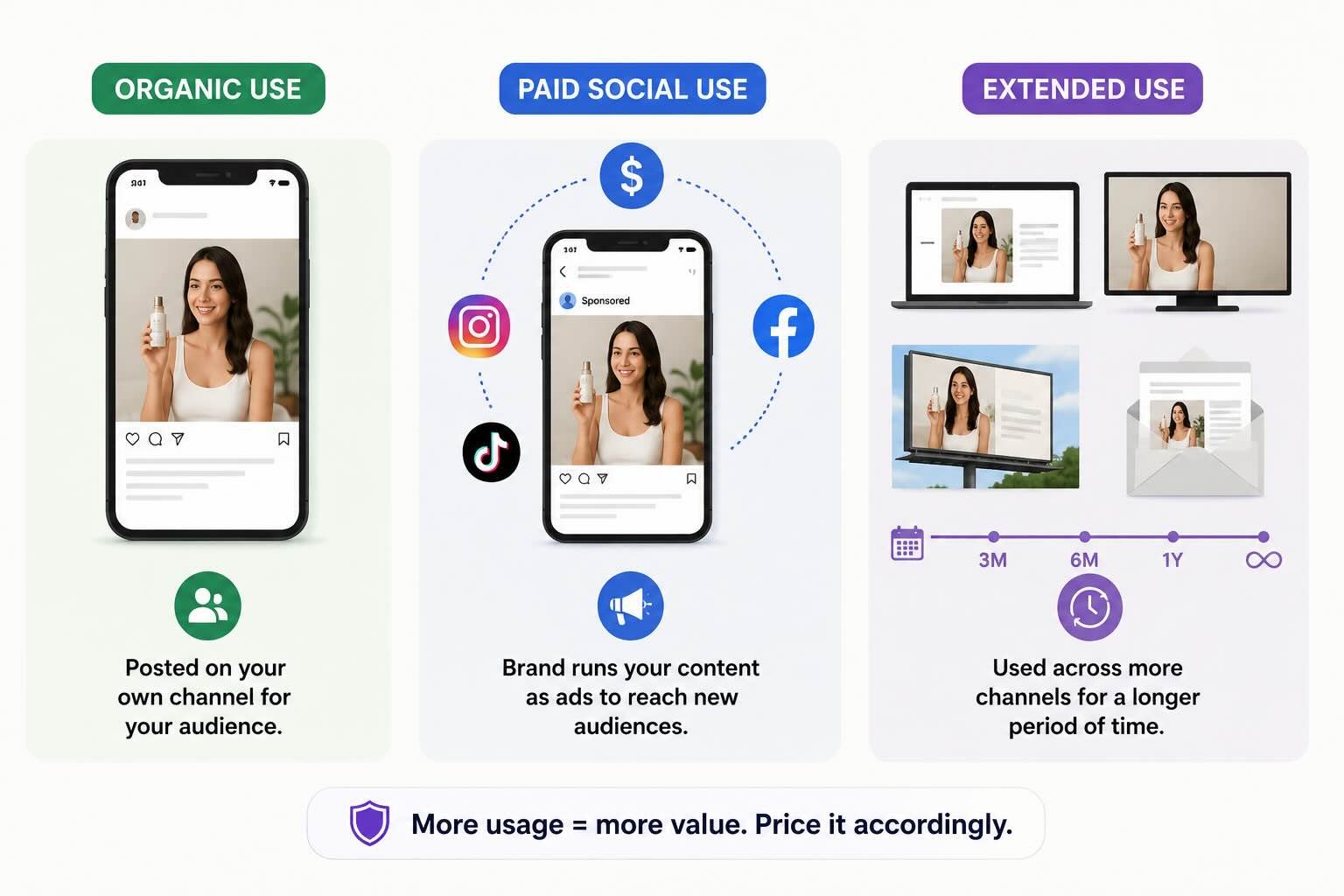
Usage rights define how the brand can use the content you make, on which channels, and for how long. This is where most of the hidden money lives.
Here's the thing creators miss: posting a Reel on your own feed for your own audience is one thing. A brand taking that same video and running it as a paid ad to millions of people, or putting it on a billboard, or using it on their homepage for the next three years, is a completely different level of value. That extra usage is worth more, and you should be paid for it.
Things to look for in a usage rights clause:
- Where: Just the brand's organic social? Paid social ads too? Their website, email, retail displays, TV? The wider the usage, the higher your rate should be.
- How long: 3 months, 6 months, a year, or "in perpetuity" (forever). Perpetual rights are the most expensive thing you can give away, and brands ask for them casually. Push for a defined term.
- Paid vs. organic: "Organic use" means they repost it. "Paid use" means they put ad money behind it. Paid usage should always cost more.
A reasonable way to handle this: grant a license for a specific term and specific channels, rather than handing over ownership. If the brand wants more, that's a renewal, and a renewal is more money. As a rough rule, adding paid usage rights can mean charging 30 to 100 percent on top of your base fee. The exact number depends on scope, but the principle holds: broad, long, paid usage is premium, so price it that way.
The phrase to watch for is "worldwide, perpetual, royalty-free license to use the content in any medium." That sentence means the brand can do anything with your content, anywhere, forever, for the one flat fee. Sometimes that's fine for the right price. Just never sign it by accident.
Whitelisting and paid amplification, explained
Whitelisting (sometimes called influencer whitelisting or "allowlisting") is when you give a brand permission to run paid ads through your social handle. The ad looks like it's coming from you, posts to audiences you've never reached, and uses the brand's ad budget.
Closely related is "dark posting" or paid amplification, where the brand boosts your content as an ad without it living on your grid.
Why it matters for your contract:
- Whitelisting gives the brand access to your account's ad credibility and sometimes your audience data. That's valuable, so it's a premium add-on, often a few hundred to a few thousand dollars on top of the base deal.
- It should be time-boxed. "Whitelisting access for 60 days" is very different from indefinite access to advertise as you.
- You should know what they can spend and say. You don't want ads running through your handle that you'd never actually endorse.
If a contract includes whitelisting, treat it as a separate line item with its own fee and its own time limit. Don't let it ride along inside the base rate for free, which is exactly what happens when nobody reads the clause.
UGC contracts are a little different
A UGC (user generated content) deal is one where you make content for the brand to post on their own channels. You're not posting it to your audience, you're producing assets the brand owns or licenses.
Because of that, a UGC contract leans even harder on the clauses above:
- Usage rights are the whole deal. The brand is buying the right to use your content, so the term, the channels, and whether they can run it as paid ads are the core of what you're negotiating.
- There's usually no exclusivity or posting requirement on your side, since it isn't going on your feed. That can make UGC simpler.
- Whitelisting may not apply, but full content ownership transfer often does, so watch the IP clause closely.
UGC is often the first paid work newer creators land, so it's worth understanding the terms early. A clean UGC agreement covers deliverables, the usage license (channels plus term), revisions, and payment. That's most of it.
Red flags: terms worth pushing back on before you sign
None of these mean the brand is acting in bad faith. Some are just standard first-draft language that's written in the brand's favor, and it's completely normal to ask for changes.
- Perpetual, all-media usage rights for a single flat fee. Ask for a defined term, or price it as the premium it is.
- Open-ended exclusivity. "You may not work with competitors" with no time limit or no extra payment. Add a window and a fee.
- Unlimited revisions. Cap them at two or three rounds.
- Full IP transfer when a license would do. You can often grant usage without signing away ownership forever.
- Net 60 or longer with no deposit. Ask for a deposit, or build the wait into your price.
- No kill fee. If they can cancel after you've started and owe you nothing, you're carrying all the risk.
- Vague deliverables. "Social content as requested" can balloon. Pin down the exact posts.
A simple way to handle any of these: reply with a short, friendly note. "Happy to move forward. Two small things on the contract: can we cap usage rights at 6 months, and add a 50 percent kill fee if the campaign is canceled after I begin? Everything else looks great." Most brands say yes, because most of this is negotiable and they expect creators who know their worth to ask.
How to negotiate the terms (without a lawyer or an agent)
For years, this was the exact job a talent agent did. They read the contract, flagged the bad clauses, negotiated usage and exclusivity, and chased the payment, in exchange for 15 to 20 percent of everything you earned.
That model has a built-in problem: agents only take it on for the biggest creators, because a percentage of a small deal isn't worth their time. So the creators who most need someone to read the contract (everyone outside the top 1 percent) are the ones who never had access to that help. It was never that those creators couldn't be bothered. The commission model just wasn't built to serve them.
The good news is that the actual work is learnable and increasingly automatable:
- Know the clauses (you now do).
- Decide your non-negotiables before you reply (usage term, exclusivity fee, deposit, kill fee).
- Push back in one friendly message, bundling your asks together.
- Get the final terms in writing before you create anything.
You don't need a Rolodex or a law degree to do this. You need to know what to look for, which is most of the battle.
Free influencer contract template
Here's a plain-language template you can copy, fill in, and send. It covers the essentials for a standard creator-brand deal. For high-value or complicated deals, have a lawyer review it. For everyday partnerships, this protects you and looks professional.
Copy it, swap in your details, delete the sections that don't apply, and keep a signed copy for every deal. Even just having this ready makes you look like a creator who runs a real business, which is exactly the impression that gets you taken seriously.
Where Trovio fits
Reading the contract, flagging the usage and exclusivity traps, setting the kill fee, getting it in writing: that's the agent work most creators never had access to, because the commission model only ever served the top of the market.
That's the gap Trovio is built to close. Trovio is a digital talent agent for creators of every size, from 500 followers to 500,000. It helps with the parts an agency handles, like finding brand deals, building your media kit, guiding your rates, and managing the deal. The difference is that Trovio doesn't take a percentage of your brand partnerships. You keep 100 percent of what you earn.
Your next step
If you take one thing from this post: the rate is only half the deal. The terms underneath it (usage, exclusivity, whitelisting, payment timing) are where creators quietly win or lose money, and all of it is readable and negotiable once you know what you're looking at.
Save the template above. Use it on your next deal. And if you'd rather not handle the brand-finding, pitching, and deal terms manually, that's exactly what Trovio is for, built for creators of every size, and never taking a cut of your earnings.
Start free at create.gotrovio.com.
Andrew Lukas is co-founder and CEO of Trovio. andrew@gotrovio.com