Influencer Pitch Template: How to Email Brands in 2026
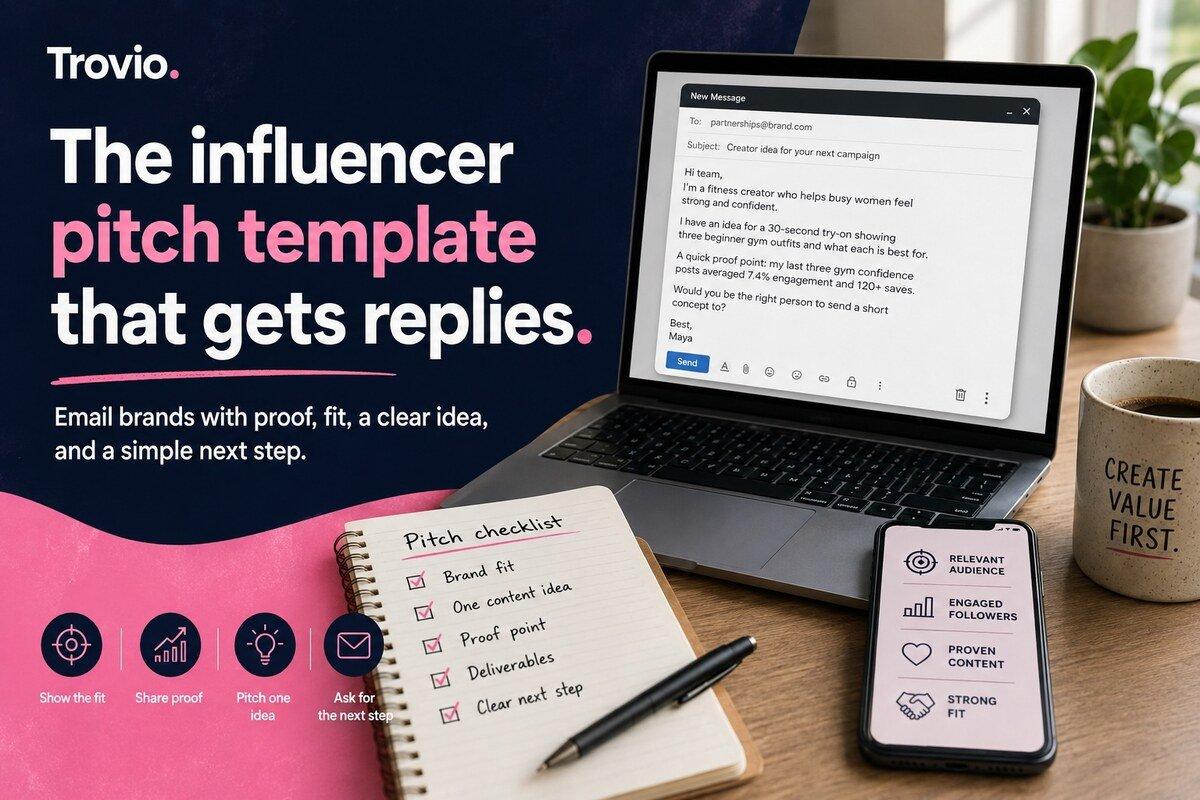
An influencer pitch email should be short, specific, and proof-led. Lead with why the brand fits your audience, name one concrete content idea, show one or two proof points, and end with a simple next step.
That is the whole job. You are not begging for a collab. You are making it easy for a marketer to understand the match, imagine the asset, and reply without doing extra work.
TL;DR / The short version
- Use one tight pitch: fit, proof, idea, deliverables, next step.
- Personalize the first two lines. Do not fake fandom or copy a mass email.
- Keep pricing out of the first cold email unless the brand asked for rates.
- Fresh Ahrefs data pulled 2026-07-01 shows “influencer pitch template” at 150 U.S. monthly searches, KD 0, and 350 traffic potential; “influencer pitch email template” adds 80 volume at KD 0.
Trovio's brand thesis is simple: small creators should not need a human agent or a commission split to look business-ready. A good pitch template is the first version of that business system. It turns “what do I even say?” into a repeatable, proof-backed outreach habit.
If you need pricing after a brand replies, pair this with the influencer rate card guide. If you need a proof document first, use the influencer media kit guide. If you are still building a work sample set, start with how to become a UGC creator.
Influencer pitch template is a reusable email structure for creator-to-brand outreach. Brand fit is the overlap between a creator's content pillar, the audience's problem, and the brand's product. Creator proof is evidence that the audience responds: engagement, saves, comments, past work, or repeated audience questions.
What should an influencer pitch email include?
Fresh Ahrefs Keywords Explorer data pulled 2026-07-01 shows “influencer pitch template” at 150 U.S. monthly searches, KD 0, and 350 traffic potential. The search intent is practical; therefore, creators want the exact pieces of a brand email, not a lecture about networking.
Use this structure:
- One personalized opener that proves the email is not a blast.
- One fit sentence about your audience, content pillar, or past post.
- One campaign idea the brand could actually picture.
- One proof point such as engagement, saves, comments, or a relevant audience detail.
- One clear ask for the right contact, a brief call, or permission to send a concept.
Here is the base template:
Subject: Creator idea for [Brand]

Hi [Name],

I’m [Your Name], a [niche] creator who helps [audience] [outcome]. I liked [specific product, campaign, or brand moment] because [real reason tied to your audience].

I have an idea for [specific content concept]: [one-sentence concept]. It would show [brand/product] in a way that feels useful to [your audience], not like a forced ad.

A quick proof point: [metric, audience detail, or relevant post result]. I can send a short concept deck, examples, or package options if this is useful.

Would you be the right person to send that to?

Best,
[Name]
[Platform links]
The point is not to sound “professional” in a generic way. The point is to make the brand's internal forward easy. A marketer should be able to paste your email into Slack and say, “This creator has a relevant audience and a usable idea.”
Citation capsule: Ahrefs Keywords Explorer data pulled by Trovio on 2026-07-01 listed “influencer pitch template” at 150 U.S. monthly searches, KD 0, and 350 traffic potential. Therefore, pitch templates are a low-difficulty, product-adjacent content gap for creator business education. The format should be copy-ready because the searcher is trying to send an email, not study outreach theory.
How do you personalize a brand pitch without wasting hours?
Ahrefs Keywords Explorer data from 2026-07-01 also shows “how to reach out to brands as an influencer” at 150 U.S. monthly searches, KD 2, and an AI Overview. That means Google already sees the query as answerable; however, the advice still needs creator judgment, not generic swipe copy.
Use a two-line personalization rule. Spend five minutes finding one real match, then stop. You are looking for one of these:
| Personalization angle | Good example | Weak example |
|---|---|---|
| Product fit | “Your travel-size moisturizer fits my carry-on skincare series.” | “I love your products.” |
| Audience fit | “My audience asks about budget gym outfits every week.” | “My followers would love this.” |
| Content fit | “Your launch would work as a three-part try-on test.” | “I can create content for you.” |
| Brand gap | “I noticed you show gym use, but not beginner runners.” | “I have creative ideas.” |
Do not personalize by writing a paragraph about the founder story unless it connects to your audience. The brand cares about fit, proof, and usable content.
The creator mistake we see most often is over-personalizing the first email and under-explaining the idea. A warm opening helps. A specific content concept gets the reply.
Citation capsule: Trovio's 2026 Ahrefs pull showed “how to reach out to brands as an influencer” at 150 U.S. monthly searches and KD 2. The SERP includes an AI Overview, People Also Ask, discussions, and paid results; as a result, concise answer-first templates are the clearest format. The winning answer should show personalization rules, proof examples, and a follow-up script.
Which pitch template should you use for a first brand email?
“Influencer pitch email template” has 80 U.S. monthly searches and KD 0 in the 2026-07-01 Ahrefs pull. Start with a low-friction email that asks for the right person or permission to send a concept, not a five-page proposal.
Use this first-contact version when you do not know the marketing contact:
Subject: Quick creator idea for [Brand]

Hi [Name/Team],

I’m [Name], a [niche] creator making content for [audience]. I’m reaching out because [specific brand/audience fit].

I have a simple content idea: [one sentence]. It would help [audience] understand/use/try [product] through [format].

One quick proof point: [relevant metric, audience signal, or past post].

Who is the best person to send a short concept to?

Thanks,
[Name]
[Links]
Use this warmer version when you already have the right person:
Subject: [Brand] x [Your Name] — [specific idea]

Hi [Name],

I’m [Name], a [niche] creator focused on [content pillar]. Your [product/campaign] stood out because [specific reason tied to your audience].

I’d love to create [deliverable idea] around [specific use case]. My audience has been asking about [audience pain point], and this would let me show [brand/product] in a practical way.

Relevant proof: [metric, audience detail, past result, or media kit link].

If this fits your upcoming priorities, I can send a one-page concept with deliverables and timing.

Best,
[Name]
Keep your first pitch under about 175 words. The follow-up can include package options, a media kit, or a rate card if the brand engages.
Citation capsule: Ahrefs Keywords Explorer listed “influencer pitch email template” at 80 U.S. monthly searches and KD 0 on 2026-07-01. A first-contact template should therefore optimize for fast comprehension: fit, idea, proof, and a low-pressure next step. The best first email earns permission to continue; it does not try to close scope, pricing, and rights at once.
What proof points should a small creator put in a pitch?
Trovio's brand foundation says the primary creator audience is sub-50k creators who post consistently but freeze at the business outreach step. Proof does not have to mean huge follower count; instead, it means evidence that your pillar and audience are real.
Use proof like this:
| Proof type | What to write | Why it works |
|---|---|---|
| Engagement signal | “My last three skincare demos averaged [X]% engagement.” | Shows active audience response |
| Audience question | “My comments keep asking for beginner-friendly meal prep.” | Shows demand for the content idea |
| Save/share behavior | “This checklist post drove [X] saves.” | Shows utility, not vanity |
| Past brand work | “Here are two sponsored examples with clear deliverables.” | Shows reliability |
| Pillar clarity | “I make budget fitness content for new gym-goers.” | Shows brand fit quickly |
Do not apologize for being small. Small creators often win because they are specific. The pitch should make that specificity obvious.
If you do not have numbers yet, use content proof. Link one relevant post. Explain why that post maps to the brand. Offer a simple concept the brand can evaluate.
A proof point should reduce the brand's uncertainty. Follower count is only one kind of proof. A sharp pillar, repeated audience questions, and a clean past example can do the same job for early creators.
Citation capsule: Trovio's brand foundation identifies sub-50k creators as the primary audience and says the business-outreach step is the common blocker. For those creators, pitch proof should emphasize pillar clarity, audience response, and deliverable fit rather than follower count alone.
Should you include rates in your first influencer pitch?
Ahrefs data pulled 2026-07-01 shows “ugc pitch template” at 70 U.S. monthly searches and KD 0, while prior Trovio pulls showed low-difficulty rate-card demand. Creators are searching for both outreach words and pricing structure, but those belong in different moments.
Usually, do not include rates in the first cold email. First, get the right person and confirm fit. Then send a short concept with package options, timeline, usage-rights assumptions, and pricing.
There are exceptions. Include pricing sooner if the brand asks for rates, the marketplace form requires it, or you are replying to a specific campaign brief. Even then, name what is included. “$X for one Reel” is incomplete if usage rights, revisions, whitelisting, exclusivity, and timeline are unclear.
The FTC's Disclosures 101 for Social Media Influencers also reminds creators that sponsored relationships should be disclosed clearly. Your pitch is not the disclosure itself, but it should make paid collaboration expectations clean from the start.
Citation capsule: FTC influencer guidance says paid creator-brand relationships require clear disclosure. A brand pitch should support that professional baseline by separating the first outreach email from the later scope, pricing, usage-rights, and disclosure details.
Interactive: build your pitch in five fields
Fill in five fields — niche, brand fit, proof, idea, and next step — and copy a ready-to-edit draft pitch.
Interactive template
Build a brand pitch in five fields
Fill in the proof. Keep the voice yours. This drafts a short first email you can edit before sending.
Draft pitch
The workflow mirrors Trovio's product promise: no blank page. A creator still owns the voice and idea, but the structure removes the freeze.
How should you follow up after a brand pitch?
The same Ahrefs pull shows “brand collaboration email template” at 50 U.S. monthly searches and KD 1. Follow-up intent is smaller than the main pitch query, but it matters because most outreach dies after one email.
Send one clean follow-up after three to five business days:
Subject: Re: Creator idea for [Brand]

Hi [Name],

Quick follow-up on the idea below. I still think [specific concept] could be useful for [brand/audience reason].

If now is not the right time, no worries. Would it be better for me to reconnect around [season, launch, or campaign window]?

Best,
[Name]
Then stop or move the brand into a later nurture list. Do not send five “just checking in” emails. A clean follow-up keeps the door open without turning your name into inbox noise.
Citation capsule: Ahrefs listed “brand collaboration email template” at 50 U.S. monthly searches and KD 1 on 2026-07-01. That supports a lightweight follow-up section: creators need a second-touch script, but the main value remains the first pitch template.
Common influencer pitch mistakes to avoid
“Influencer outreach template” has 150 U.S. monthly searches, KD 6, and 500 traffic potential in Ahrefs 2026-07-01 data. The demand is broader than one email, so the mistakes are about outreach systems, not only copy.
Avoid these:
- Making the email about you first. Start with brand-audience fit.
- Pitching “content” with no idea. Give the marketer a concrete angle.
- Sending a rate card too early. Confirm fit before pricing unless asked.
- Hiding usage rights. Paid usage, exclusivity, and whitelisting change scope.
- Using fake enthusiasm. Real specificity beats generic compliments.
- Forgetting disclosure. Sponsored content needs clear disclosure once a deal happens.
The best pitch feels easy to say yes or no to. That is a feature, not a flaw. A clear no saves time. A clear yes gives you a real next step.
Citation capsule: Ahrefs listed “influencer outreach template” at 150 U.S. monthly searches, KD 6, and 500 traffic potential in July 2026. That broader demand suggests creators need outreach judgment: fit, proof, rights, and follow-up discipline, not only swipe copy.
FAQ
What is the best influencer pitch template?
The best influencer pitch template includes one personalized opener, one audience-fit sentence, one content idea, one proof point, and one next step. Ahrefs data pulled 2026-07-01 shows “influencer pitch template” at KD 0, so a practical, copy-ready format is a winnable search angle.
How long should an influencer pitch email be?
Keep a first influencer pitch email under about 175 words. The search demand is practical: “influencer pitch email template” has 80 U.S. monthly searches and KD 0 in Trovio's 2026-07-01 Ahrefs pull, so creators need a fast email, not a long proposal.
Should small creators pitch brands?
Yes. Trovio's brand foundation defines the primary audience as sub-50k creators who post consistently but freeze at outreach. Small creators should pitch when they can show pillar clarity, audience fit, and a useful content idea, even before they have huge follower numbers.
Should I attach my media kit to the first pitch?
Usually, link it lightly or offer to send it. If the email gets too heavy, the brand may not read it. Use a media kit after the first sign of interest, especially if it includes proof, audience details, examples, and package options.
How many times should I follow up with a brand?
Send one thoughtful follow-up after three to five business days, then stop or reconnect around a relevant campaign window. Ahrefs shows “brand collaboration email template” at 50 U.S. monthly searches and KD 1, so a simple second-touch script is useful without becoming spammy.
Sources
- Ahrefs, Keywords Explorer overview for “influencer pitch template,” “influencer pitch email template,” “how to reach out to brands as an influencer,” “ugc pitch template,” “brand collaboration email template,” and “influencer outreach template,” pulled by Trovio on 2026-07-01.
- Ahrefs, Keywords Explorer matching terms for “influencer pitch template,” pulled by Trovio on 2026-07-01.
- Trovio Brand Foundation (internal brand and audience guidelines), updated 2026-06-23.
- Federal Trade Commission, Disclosures 101 for Social Media Influencers, retrieved 2026-07-01, ftc.gov
Final note
A pitch template should not erase your voice. It should protect it from the blank page. Start with fit, proof, and one real idea. Then let the brand see the business case quickly. And once the replies start coming, how to get brand deals as a creator covers the rest of the pipeline.