How to Build a UGC Portfolio in 2026 (With Examples + Free Template)
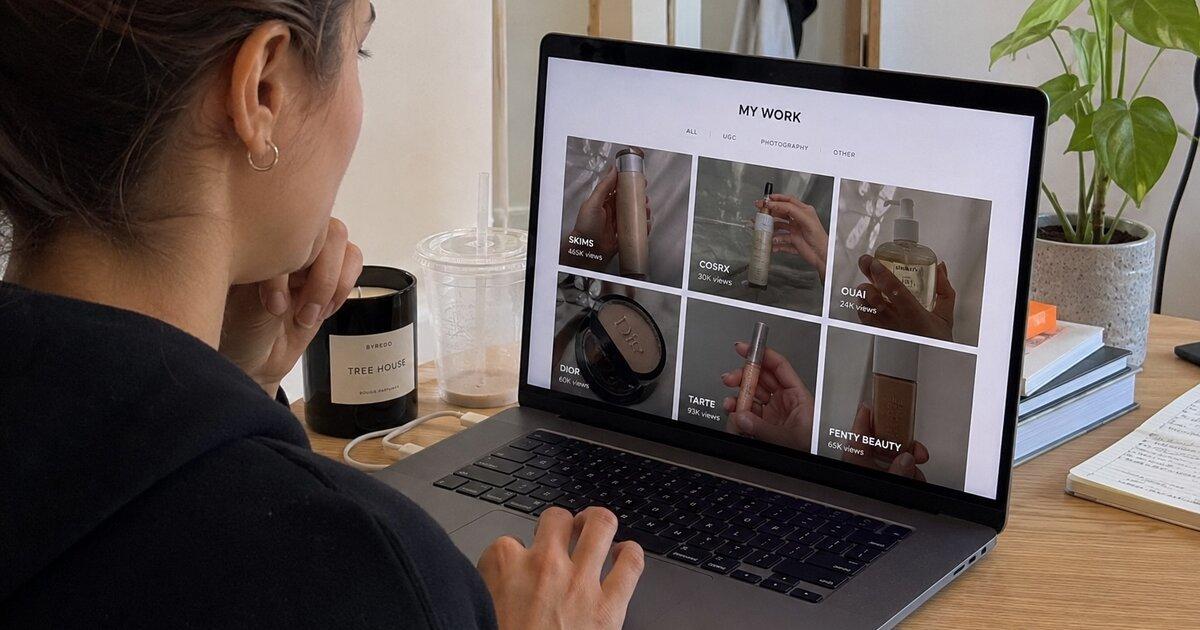
Here's the thing no one says out loud: brands hire UGC creators off the portfolio, not the follower count. It's the first thing they ask for, and it's what decides whether you get the deal. The good news — you can build one this weekend with three videos and a free link. This guide shows you exactly what goes in it, what "good" looks like, and gives you a checklist to build your own.
If you're brand new to all this, start with our guide on what a UGC creator is and how to become one. Already know the basics? Let's build your portfolio.
The short version
- Your portfolio matters more than your following — brands buy UGC because it converts, and they need proof you can make it.
- The strongest portfolios show 3 things: content variety, clear brand-fit, and results per sample.
- You need ~5–10 great pieces on a mobile-friendly link — not a giant pile.
- It's also how you charge more: a portfolio is your proof, so you stop competing on price.
What is a UGC portfolio (and why it beats followers)?
A UGC portfolio is a short, curated set of content samples that shows a brand you can make authentic, ad-style videos for their product. It exists because brands aren't buying your audience — they're buying content for their ads, and 77% of shoppers say they're more likely to buy after seeing real creator content (Bazaarvoice, 2024). That preference runs deep: 92% of people trust recommendations and real content over traditional ads (Nielsen, 2012). Your portfolio is the proof you can produce the kind of content that earns that trust.
This is why "how many followers do I need" is the wrong question — the portfolio answers a different one: can this person make content that sells?
What goes in a portfolio that actually lands deals?
A strong portfolio leads with results and brand-fit, not aesthetics. Brands trust real creator content 2.4x more than brand-made content (Stackla/Nosto, 2019) — so they're scanning for authentic and on-brand, then did it work. Here's the difference between a portfolio that gets ignored and one that gets you booked:
| Gets ignored | Lands deals | |
|---|---|---|
| Leads with | Follower count | Results + brand-fit samples |
| Content range | One format, over-polished | Variety across formats & funnel stages |
| Each sample | Just the video | Video + the hook + a result (views, CTR, sales) |
| Format | A PDF nobody opens | A fast, mobile-friendly link |
| Vibe | Generic reel | Clearly fits that brand's look |
Note the "mobile-friendly" row: brand managers review these on their phones, so a clunky PDF is an instant scroll-past.
How do you build a UGC portfolio from scratch?
You build it by creating 3–5 spec videos, packaging each with its hook and result, and putting them on a simple public link organized by niche. You don't need past clients — spec work (samples for products you already own) counts. Here's the build order:
1. Make 3–5 spec videos
Pick products you actually use and film short, authentic demos — an unboxing, a "3 reasons I love this," a problem/solution. These are your samples. (More on filming in how to become a UGC creator.)
2. Add context to each sample
Under each video: a one-line hook, the format, and any result you have ("3.2% CTR," "drove 40K views"). No results yet? Use spec pieces and note the intent ("hook designed for thumb-stop in 2 seconds"). Showing you think about performance is half the battle.
3. Group by niche
Brands want to see you get their world. Cluster samples — beauty, food, tech, wellness — so a skincare brand instantly sees your skincare work.
4. Put it on a mobile-friendly link
A simple page (Notion, a portfolio tool, or your own site) beats a PDF. Add your name, niches, contact, and rates. Pair it with a proper media kit as you grow.
At Trovio, the creators who land deals fastest almost always have a portfolio ready before they pitch — when a brand asks "got examples?", they send a link in seconds instead of scrambling. Having it ready is the unlock. We help build it (and draft the pitch that goes with it), and we never take a cut of the deal.
What do good UGC portfolio examples look like?
The best examples share a pattern: ~10 pieces, not 50, organized by niche, each with a result or a clear creative rationale. Brands consistently rank UGC content over polished brand ads — UGC drives meaningfully higher engagement and conversion (Bazaarvoice, 2024) — so your examples should look like content that converts, not a glossy showreel. Three structures that work:
- The niche specialist — 6–8 videos all in one lane (e.g., skincare), each with a result. Reads as "expert."
- The range generalist — 10 videos across 3 niches and 3 formats, showing flexibility.
- The performance-led — fewer videos, but each paired with hard numbers (views, CTR, sales). Best if you have data.
What a strong entry actually looks like: Skincare — "Why I switched to [Brand]'s vitamin C serum" ¬∑ 0:32 vertical ¬∑ Hook: "I wasted $200 on serums before this one." ¬∑ Result: 3.1% CTR, 41K views on the brand's TikTok ad. That one line of context turns a clip into evidence.
We practice what we preach on this. Trovio just had its most successful week of signups ever, and it came off a UGC campaign we ran with a creator whose entire niche is creator tools. We picked them because of that niche focus — it made them an obvious fit, no guesswork. That's the exact signal a tight, niche-grouped portfolio sends to a brand, and it's why this approach works.
Common mistakes that get portfolios ignored
A few patterns make a brand click away fast:
- Leading with follower count instead of the work — they're hiring content, not reach.
- No context under a sample — a video with no hook or result is just a clip, not proof.
- Sending a PDF — it's clunky on a phone, which is where brands actually review.
- One format only — no range reads as a one-trick creator.
- No niche grouping — if a beauty brand can't instantly find your beauty work, they move on.
Your UGC Portfolio Checklist
Tick these off and you've got a portfolio a brand will take seriously.
Frequently Asked Questions
Do I need a portfolio if I have no clients yet?
Yes — and you don't need clients to make one. Use spec videos (samples for products you already own). Brands evaluate UGC creators on content quality and brand-fit, not past logos, so a sharp spec portfolio can fully replace experience early on.
How many pieces should a UGC portfolio have?
Around 5–10 strong pieces, not 50. Brands skim fast, so quality and variety beat volume. A focused set — a few formats, grouped by niche, each with a hook or result — reads stronger than a giant unsorted pile.
Where should I host my UGC portfolio?
On a fast, mobile-friendly link — a simple Notion page, a portfolio tool, or your own site. Avoid PDFs; brand managers review on their phones. Include your name, niches, contact, and rates so a brand can act without emailing back for basics.
Does a portfolio help me charge more?
Yes. A portfolio is your proof, so you stop competing on price and start competing on results. Brands earn about $4 back for every $1 spent on UGC (Bazaarvoice, 2024) — a portfolio that shows you drive that ROI justifies a higher rate.
Is UGC still worth getting into in 2026?
Yes. The UGC platform market is projected to grow from $8.48 billion in 2026 to $64.31 billion by 2034 (Fortune Business Insights, 2026), so brand demand for creators with proof keeps rising.
The bottom line
Your UGC portfolio is the single highest-leverage asset in your creator business — it's what brands judge you on, and it's what lets you charge real rates. Make 3–5 spec videos, add a hook and result to each, group them by niche, and put them on a mobile-friendly link. That's it.
The part that trips people up is doing it consistently while also pitching. See how Trovio builds your portfolio and drafts your pitches — without taking a cut. And when you're ready to send it out, here's how to get brand deals as a creator.
Sources
- Bazaarvoice, "User-generated content statistics to know" (77% purchase lift, $4-per-$1 ROI), retrieved 2026-06-18 — https://www.bazaarvoice.com/blog/user-generated-content-statistics-to-know/
- Stackla / Nosto consumer survey (UGC 2.4x more likely to be seen as authentic than brand content), retrieved 2026-06-18 — https://www.nosto.com/blog/stackla-survey-reveals-disconnect-between-the-content-consumers-want-what-marketers-deliver/
- Fortune Business Insights, "User-Generated Content Platform Market" ($8.48B 2026 ‚Üí $64.31B 2034), retrieved 2026-06-18 — https://www.fortunebusinessinsights.com/user-generated-content-platform-114207
- Nielsen, "Global Trust in Advertising" (92% trust recommendations/real content over ads), retrieved 2026-06-18 — https://www.nielsen.com/insights/2012/global-trust-in-advertising-and-brand-messages-2/