UGC Creator: What It Is, Pay & How to Start (2026)
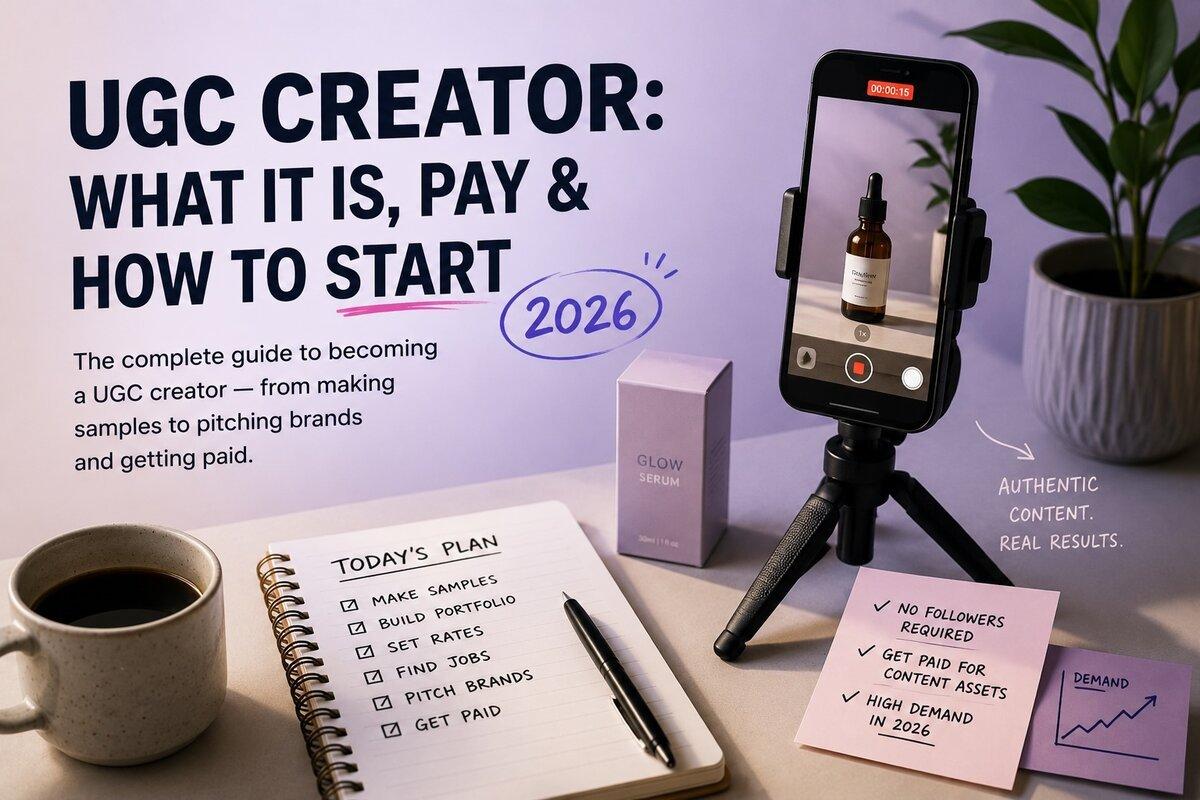
A UGC creator is someone brands pay to make authentic-looking photos and videos that the brand posts on its own channels and ads — not the creator's. You're paid for the content itself, not for your audience or reach. That's the whole difference between UGC and influencing, and it's why you can start with zero followers.
The short version
- A UGC (user-generated content) creator sells content assets to brands; an influencer sells access to an audience.
- You don't need a following. You need a small portfolio of good sample videos and the ability to pitch.
- You're paid per deliverable (e.g. three vertical videos) plus usage rights, not per follower.
- "UGC creator" draws 21,000 U.S. searches a month (Ahrefs, pulled 2026-07-06, KD 14) — one of the biggest, most winnable creator-career topics right now.
- This page is the map; each section links to a deep guide for the step you're on.
Trovio's whole thesis is that a small creator shouldn't need a human agent taking a 20% cut to run a real content business. UGC is the clearest proof of that: it's a job you can start this month, price yourself, and get paid for directly. So use this guide as the hub — start here, then follow the link into whichever step you're actually on.
What is a UGC creator?
A UGC creator is a paid content producer who makes authentic-style photos and videos for a brand to use, in the format of a normal customer post. The brand then runs that content as an ad, on its own social channels, or on product pages, because it converts better than polished studio work. The content looks organic; however, the arrangement is commercial and work-for-hire. In our work with creators at Trovio, this is the single most misunderstood point: you're producing an asset the brand owns the right to use, not a post on your own feed. That distinction changes everything downstream — how you price, what you deliver, and why follower count barely matters.
Compare that to an influencer, who is paid to post to their own audience. An influencer is paid for reach; a UGC creator is paid for the asset. Many creators do both, because the skills overlap, but they're different products with different pricing. Want the full definition, with real deliverable examples? Read the deep dive: what is a UGC creator.
Citation capsule: Ahrefs Keywords Explorer data pulled by Trovio on 2026-07-06 shows "ugc creator" at 21,000 U.S. monthly searches with a keyword difficulty of 14 and an AI Overview on the results page. Related terms "what is a ugc creator" (2,900) and "ugc creator meaning" (1,700) confirm that most of the demand is people trying to understand the role before they start.
UGC creator vs. influencer: what's the real difference?
The fastest way to understand UGC is to put it next to influencing, side by side.
| UGC creator | Influencer | |
|---|---|---|
| Who posts it | The brand, on its channels/ads | You, on your channel |
| What you sell | The content asset + usage rights | Access to your audience |
| Followers needed | Not really — portfolio matters | Yes, reach is the product |
| You're paid for | Deliverables (videos, photos) | Reach, posting, engagement |
| Typical output | 1–3 vertical videos, a photo set | A post, story, or integration |
If you have a small but engaged audience, however, you can layer both. To measure whether your audience is "engaged enough" to also pitch influencer deals, for instance, use the free engagement rate calculator.
How much do UGC creators make?
Honest answer: it depends on scope, not follower count, so ignore any single "average salary" number you see. Specifically, UGC pay is built from three things — the number of deliverables, the usage rights the brand wants (how long and where they can run it), and revisions. As a result, a one-video, organic-use job and a three-video, six-month paid-ads job are wildly different prices for the same filming effort.
Rather than repeat numbers here, we've broken the full model down — retainers, usage-rights add-ons, revision caps, and tax set-asides — in what UGC creators actually make. Then, when you're ready to put a real number on a quote, build a proper influencer rate card.
How do you become a UGC creator?
You become a UGC creator by making sample content and pitching it — in that order. You do not wait to be discovered. In our experience helping creators get their first paid brief, the ones who stall are almost always waiting for permission — a bigger following, a better camera, a course. Meanwhile, the ones who get booked film three rough samples this week and send them. Here's the short version of the path:
- Pick one or two content pillars (skincare, home, fitness, food) so your samples look focused.
- Film 3–5 spec videos for products you already own. No brand deal required — these are your proof.
- Build a one-page portfolio with your best samples and any results.
- Set rates by deliverable and usage, not by followers.
- Find work through marketplaces and direct outreach.
- Pitch brands with proof plus one concrete content idea, then deliver and invoice.
For the full walkthrough — camera basics, briefs, and the exact starter steps — read how to become a UGC creator. The interactive roadmap below tracks these six steps for you.
Interactive: your UGC creator roadmap
Your UGC creator roadmap
0 of 6 done- 1. Understand the role
Know what a UGC creator actually is and how it differs from an influencer. Start with what is a UGC creator.
- 2. Make 3–5 sample videos
You don't need a brand deal to start. Film spec content for products you already own. See how to become a UGC creator.
- 3. Build a simple portfolio
One page that shows your best samples and the results. Follow how to build a UGC portfolio.
- 4. Set your rates and pay expectations
Price by deliverable and usage, not by followers. See what UGC creators make and the rate card guide.
- 5. Find your first jobs
Marketplaces plus direct outreach. Use the job map in UGC jobs.
- 6. Pitch brands directly
Proof plus one concrete idea beats a mass email. Grab the influencer pitch template and how to get brand deals.
What goes in a UGC portfolio?
Your portfolio is the single most important thing you own as a UGC creator, because it replaces follower count as proof. Specifically, a good one shows 3–6 of your best sample videos, the type of product each was for, and any result you can point to. That last part matters most — a brand reuse, a view count, or a clear before/after in quality.
Templates, structure, and real examples are here: how to build a UGC portfolio. Keep it to one scannable page, because brands decide in seconds.
Where do you find UGC creator jobs?
UGC work comes from two places: marketplaces (creator platforms and job boards that match you to briefs) and direct pitching (you emailing brands you'd genuinely use). Typically, beginners start on marketplaces to build reps. Then they shift toward direct outreach, where the rates and relationships are better.
We mapped the actual sources — which platforms take beginners, what to watch for on usage rights, and how to track your pitches — in UGC creator jobs: where to find them.
How do you pitch brands and land deals?
A cold pitch that works is short and proof-led: one line on why you fit the brand's audience, one concrete content idea, one proof point, and a clear next step. In contrast, skip the paragraph about how much you "love the brand" — marketers ignore it.
- Copy-and-fill outreach email: influencer pitch template.
- The bigger playbook for landing paid work without an agent: how to get brand deals as a creator.
- A proof document to attach when brands ask: influencer media kit guide.
One compliance note worth building in from day one: when content is part of a paid arrangement, U.S. creators are expected to disclose it clearly. The FTC's endorsement guides are the primary source on what "clear and conspicuous" disclosure means — read them once and bake the habit in.
Is being a UGC creator worth it in 2026?
For most people trying to earn from content, UGC is the lowest-friction on-ramp in the creator economy: no audience to build first, a portfolio you can make in a weekend, and brands that genuinely need the volume of content. However, the tradeoff is that it's work-for-hire — in other words, you're running a small content-production business, with the admin that implies (quotes, contracts, invoices, rights, disclosure).
That admin is exactly the part Trovio automates, so a solo creator can operate like they have a team without handing 20% to an agent. The content is yours; the business system shouldn't be the thing that stops you.
Frequently asked questions
What is a UGC creator?
A UGC creator is someone brands pay to make authentic-style photos and videos that the brand uses on its own channels and ads. You're paid for the content and its usage rights, not for posting to your own audience.
Do you need followers to be a UGC creator?
No. UGC is work-for-hire content, so brands care about the quality of your samples, not your follower count. A strong portfolio matters far more than reach.
How much do UGC creators make?
It depends on the number of deliverables, the usage rights, and revisions — not on followers. See our full breakdown in the UGC creator salary guide rather than trusting a single "average."
How do I become a UGC creator with no experience?
Film 3–5 spec videos for products you already own, put them in a one-page portfolio, set rates by deliverable, and pitch brands directly. Full steps: how to become a UGC creator.
Is UGC creating legit or a scam?
The work itself is legitimate and brands pay real money for it. The scams to avoid are "pay to join" creator programs and jobs that demand free content for "exposure." Stick to reputable marketplaces and direct brand outreach.
Sources: Ahrefs Keywords Explorer (U.S.), pulled 2026-07-06 — "ugc creator" 21,000 vol / KD 14 / TP 3,400; related cluster terms as cited. FTC — Disclosures 101 for Social Media Influencers.